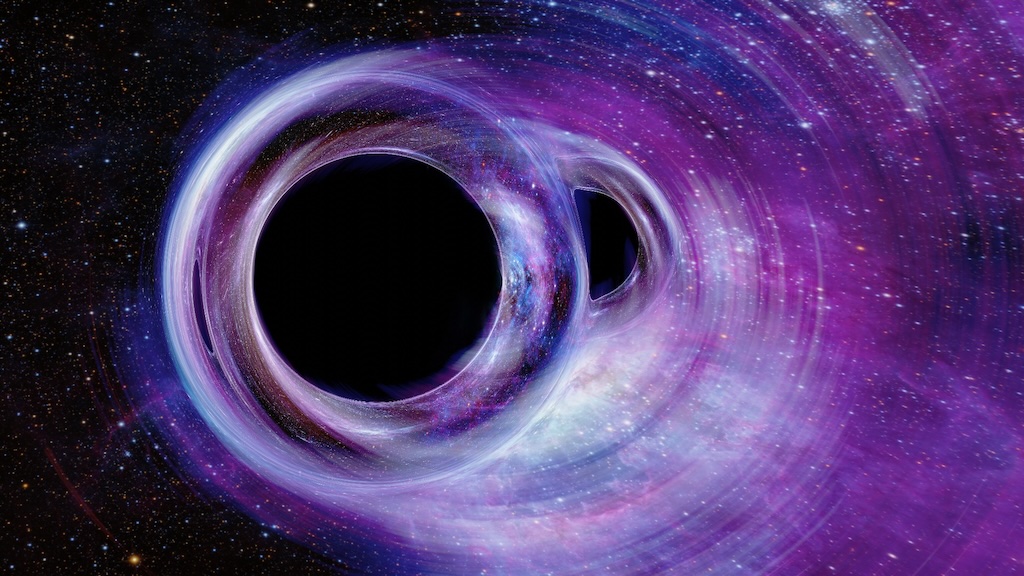
What would it look like to circle a black hole? If the black hole was surrounded by a swirling disk of glowing and accreting gas, then the great gravity of the black hole would deflect light emitted by the disk to make it look very unusual. The featured animated video gives a visualization. The video starts with you, the observer, looking toward the black hole from just above the plane of the accretion disk. Surrounding the central black hole is a thin circular image of the orbiting disk that marks the position of the photon sphere -- inside of which lies the black hole's event horizon. Toward the left, parts of the large main image of the disk appear brighter as they move toward you. As the video continues, you loop over the black hole, soon looking down from the top, then passing through the disk plane on the far side, then returning to your original vantage point. The accretion disk does some interesting image inversions -- but never appears flat. Visualizations such as this are particularly relevant today as black holes are being imaged in unprecedented detail by the Event Horizon Telescope. Singularity Impressive: It's Black Hole Week at NASA!
¿Cómo se vería orbitar un agujero negro? Si el agujero negro estuviera rodeado por un disco giratorio de gas brillante y acrecionante, la gran gravedad del agujero negro desviaría la luz emitida por el disco, haciendo que se viera de manera muy inusual. El video animado que se muestra brinda una visualización. El video comienza con usted, el observador, mirando hacia el agujero negro desde justo encima del plano del disco de acreción. Rodeando el agujero negro central hay una imagen circular delgada del disco orbitante que marca la posición de la esfera de fotones — dentro de la cual se encuentra el horizonte de sucesos del agujero negro. Hacia la izquierda, partes de la gran imagen principal del disco aparecen más brillantes a medida que se mueven hacia usted. A medida que avanza el video, usted da una vuelta sobre el agujero negro, mirando pronto desde arriba, luego atravesando el plano del disco en el lado opuesto, y finalmente regresando a su punto de vista original. El disco de acreción realiza algunas inversiones de imagen interesantes, pero nunca aparece plano. Visualizaciones como esta son particularmente relevantes hoy en día, ya que los agujeros negros se están observando con un detalle sin precedentes por parte del Telescopio del Horizonte de Sucesos. Singularidad Impresionante: ¡Es la Semana del Agujero Negro en NASA!