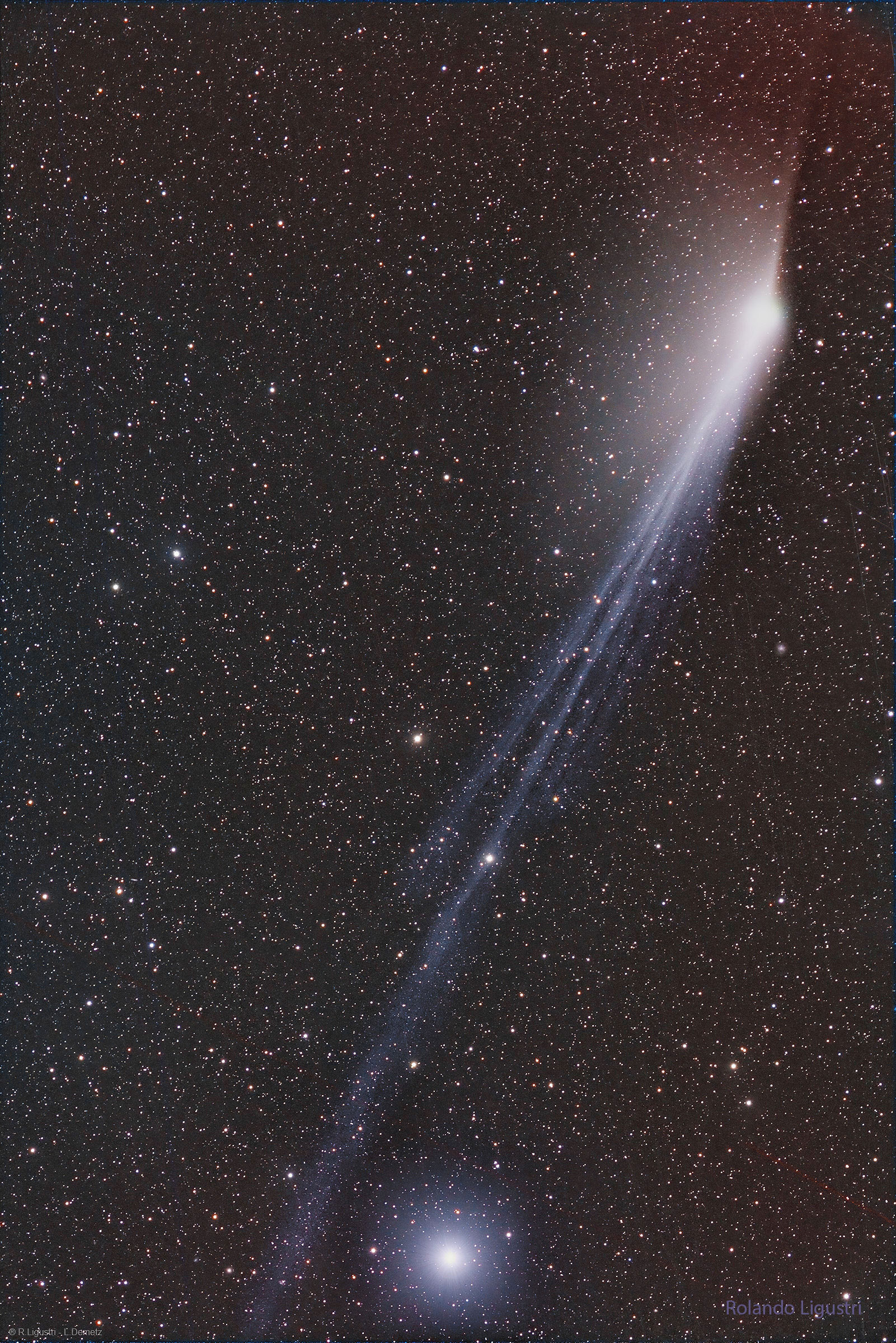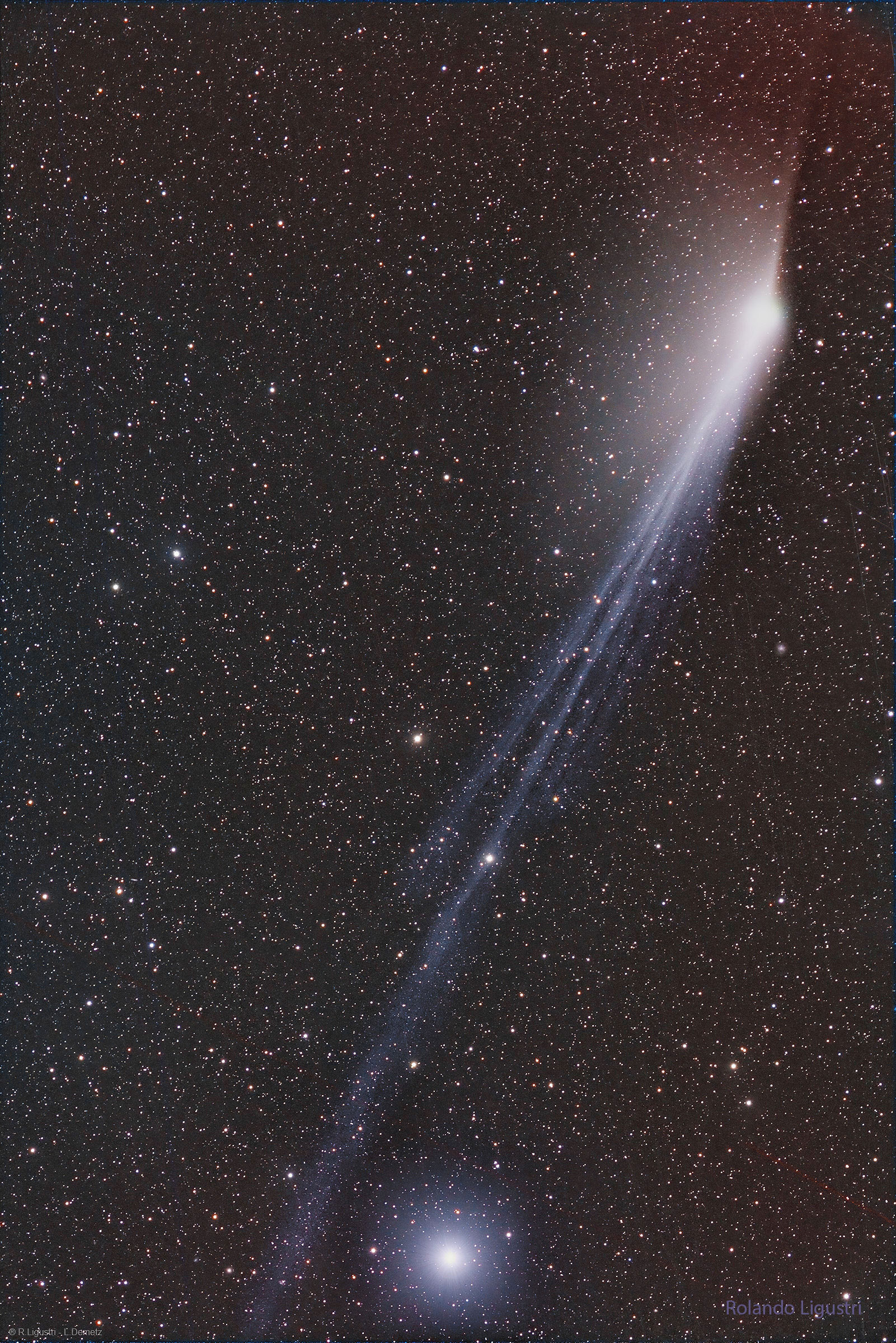
Why does Comet Pons-Brooks now have tails pointing in opposite directions? The most spectacular tail is the blue-glowing ion tail that is visible flowing down the image. The ion tail is pushed directly out from the Sun by the solar wind. On the upper right is the glowing central coma of Comet 12P/Pons–Brooks. Fanning out from the coma, mostly to the left, is the comet's dust tail. Pushed out and slowed down by the pressure of sunlight, the dust tail tends to trail the comet along its orbit and, from some viewing angles, can appear opposite to the ion tail. The distant, bright star Alpha Leporis is seen at the bottom of the featured image captured last week from Namibia. Two days ago, the comet passed its closest to the Earth and is now best visible from southern skies as it dims and glides back to the outer Solar System.
¿Por qué el cometa Pons-Brooks ahora tiene colas que apuntan en direcciones opuestas? La cola más espectacular es la cola de iones que brilla con un color azul y que se ve fluyendo hacia abajo en la imagen. La cola de iones es empujada directamente desde el Sol por el viento solar. En la parte superior derecha se encuentra la coma brillante central del cometa 12P/Pons–Brooks. Saliendo de la coma, principalmente hacia la izquierda, se encuentra la cola de polvo del cometa. Empujada y desacelerada por la presión de la luz solar, la cola de polvo tiende a seguir al cometa a lo largo de su órbita y, desde algunos ángulos de observación, puede aparecer opuesta a la cola de iones. La estrella brillante y distante Alpha Leporis se ve en la parte inferior de la imagen destacada capturada la semana pasada desde Namibia. Hace dos días, el cometa pasó más cerca de la Tierra y ahora es mejor visible desde el hemisferio sur a medida que se atenúa y se aleja hacia el exterior del Sistema Solar.