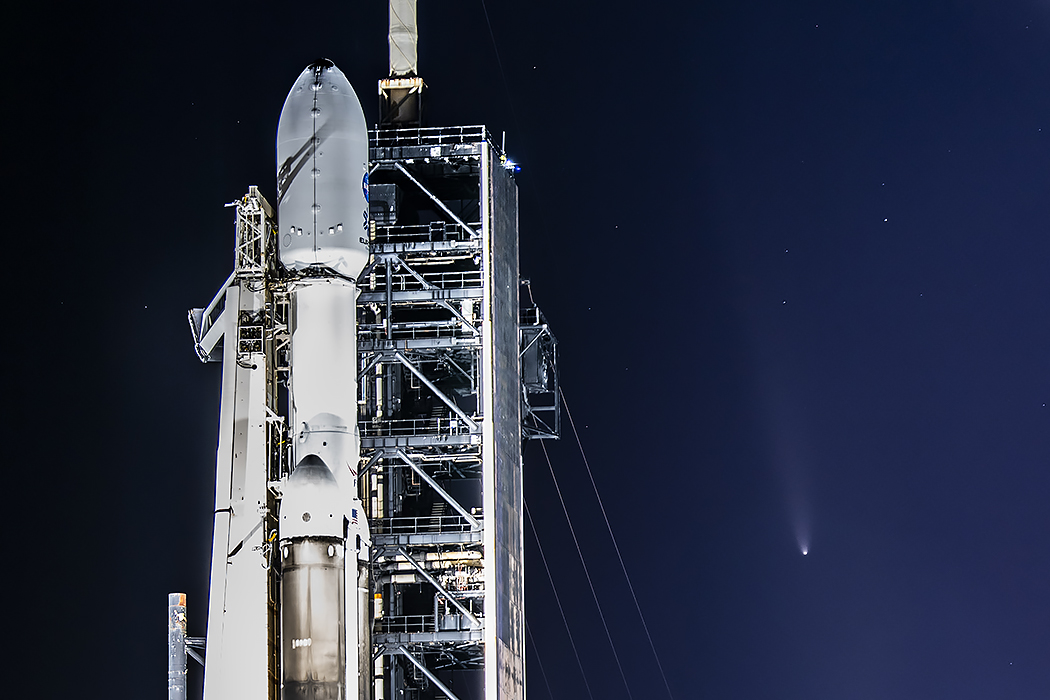
NASA's Europa Clipper is now headed toward an ocean world beyond Earth. The large spacecraft is tucked into the payload fairing atop the Falcon Heavy rocket in this photo, taken at Kennedy Space Center the day before the mission's successful October 14 launch. Europa Clipper's interplanetary voyage will first take it to Mars, then back to Earth, and then on to Jupiter on gravity assist trajectories that will allow it to enter orbit around Jupiter in April 2030. Once orbiting Jupiter, the spacecraft will fly past Europa 49 times, exploring a Jovian moon with a global subsurface ocean that may have conditions to support life. Posing in the background next to the floodlit rocket is Comet Tsuchinsan-ATLAS, about a day after the comet's closest approach to Earth. A current darling of evening skies, the naked-eye comet is a visitor from the distant Oort cloud Growing Gallery: Comet Tsuchinshan-ATLAS in 2024
El Clipper de Europa de la NASA ahora se dirige hacia un mundo oceánico más allá de la Tierra. La nave espacial de gran tamaño está acoplada en la cubierta de carga superior del cohete Falcon Heavy en esta fotografía, tomada en el Centro Espacial Kennedy el día antes del exitoso lanzamiento de la misión el 14 de octubre. El viaje interplanetario del Clipper de Europa primero lo llevará a Marte, luego de regreso a la Tierra y luego hacia Júpiter, siguiendo trayectorias de asistencia gravitacional que le permitirán entrar en órbita alrededor de Júpiter en abril de 2030. Una vez en órbita alrededor de Júpiter, la nave espacial realizará 49 sobrevuelos de Europa, explorando una luna joviana con un océano subsuperficial global que podría tener condiciones para albergar vida. Al fondo, junto al cohete iluminado por inundación, se encuentra el cometa Tsuchinsan-ATLAS, aproximadamente un día después del acercamiento más cercano del cometa a la Tierra. Este cometa visible a simple vista es un visitante del lejano nube de Oort y actualmente es una atracción en los cielos vespertinos.