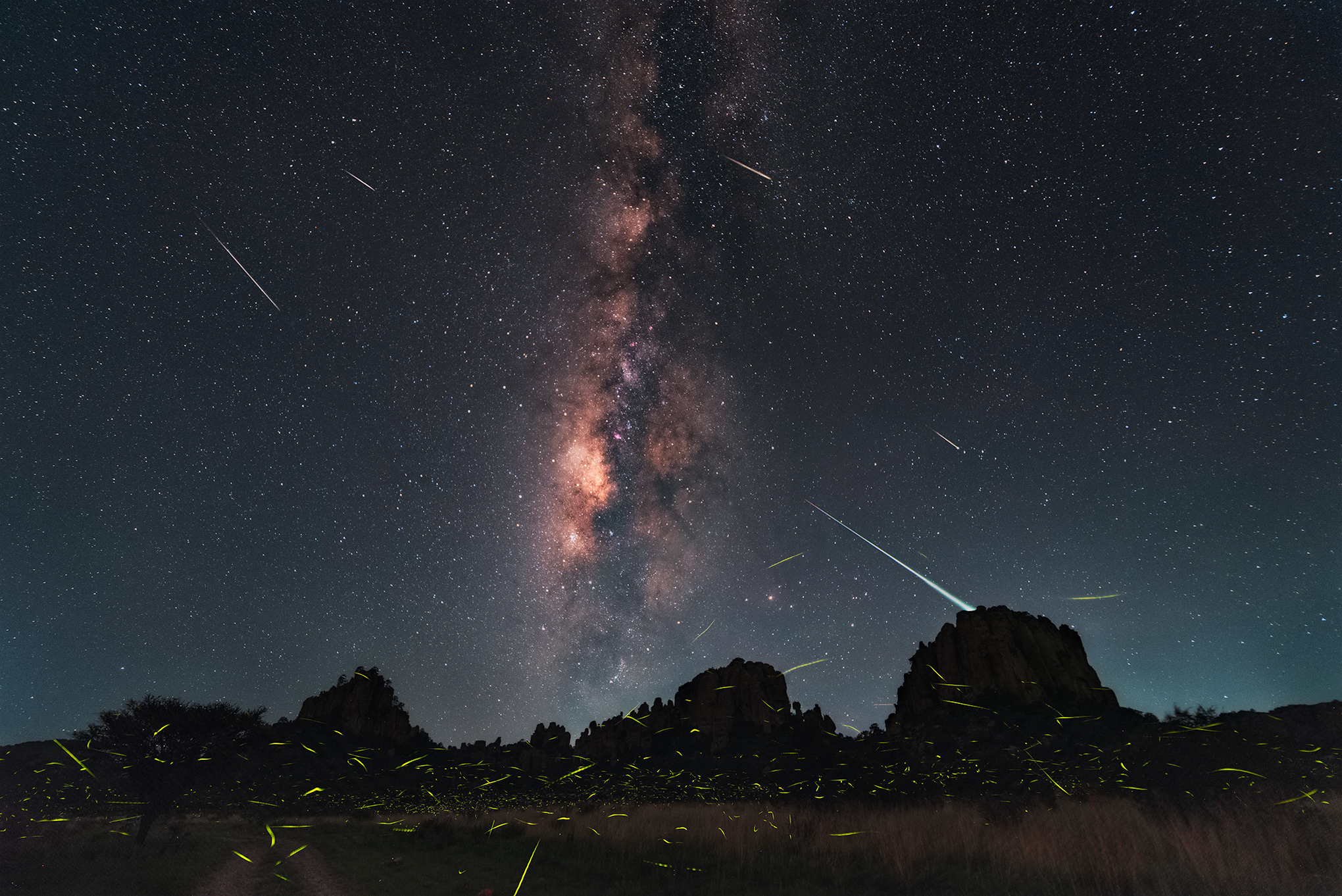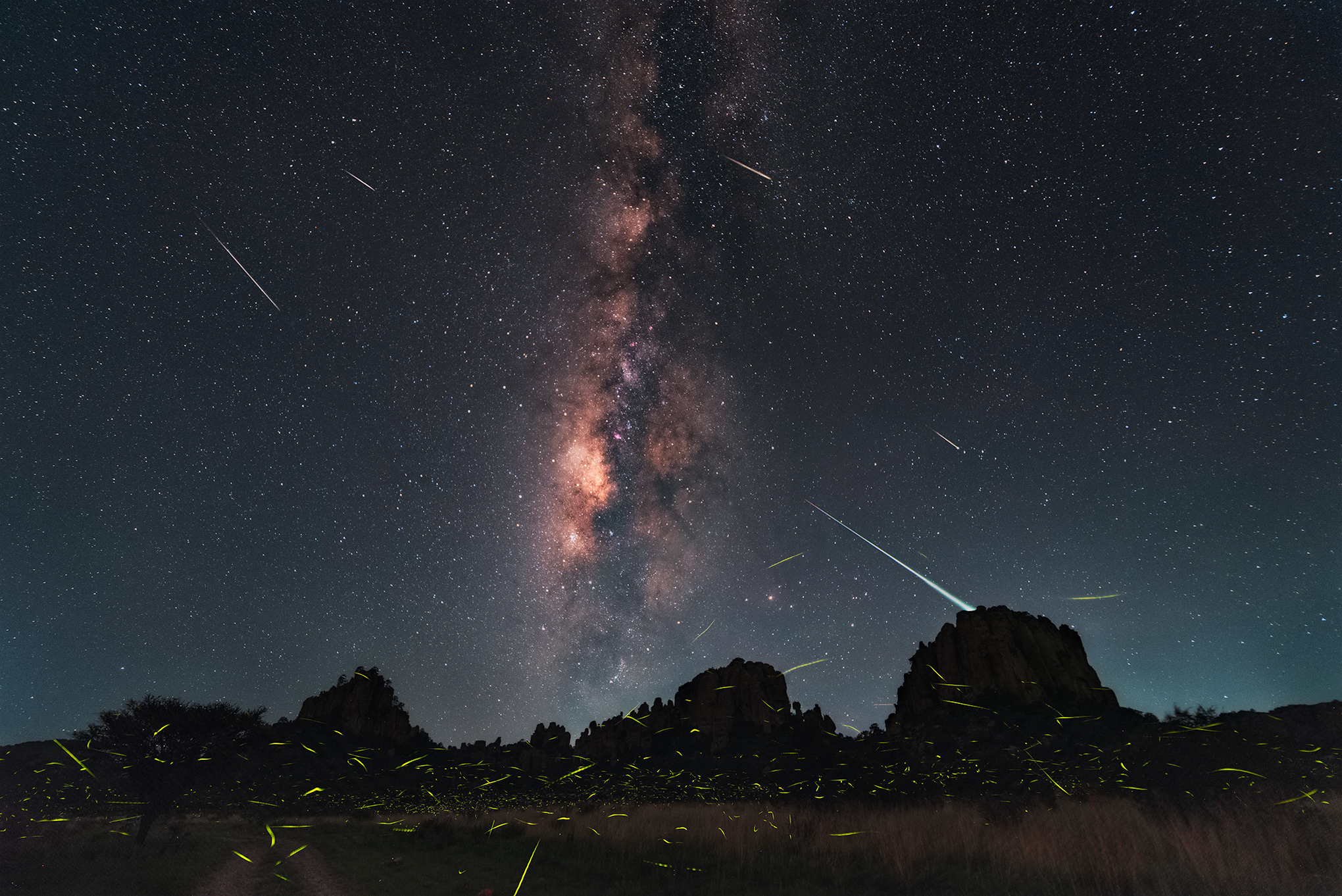
Taken on July 29 and July 30, a registered and stacked series of exposures creates this dreamlike view of a northern summer night. Multiple firefly flashes streak across the foreground as the luminous Milky Way arcs above the horizon in the Sierra de Órganos national park of central Mexico. The collection of bright streaks aligned across the sky toward the upper left in the timelapse image are Delta Aquariid meteors. Currently active, the annual Delta Aquariid meteor shower shares August nights though, overlapping with the better-known Perseid meteor shower. This year that makes post-midnight, mostly moonless skies in early August very popular with late night skygazers. How can you tell a Delta Aquariid from a Perseid meteor? The streaks of Perseid meteors can be traced back to an apparent radiant in the constellation Perseus. Delta Aquariids appear to emerge from the more southerly constellation Aquarius, beyond the top left of this frame. Of course, the bioluminescent flashes of fireflies are common too on these northern summer nights. But how can you tell a firefly from a meteor? Just try to catch one.
Tomada el 29 y 30 de julio, una serie registrada y apilada de exposiciones crea esta visión onírica de una noche de verano en el norte. Múltiples destellos de luciérnagas cruzan el primer plano mientras la luminosa Vía Láctea se arquea sobre el horizonte en el parque nacional Sierra de Órganos, en el centro de México. La colección de destellos brillantes alineados en el cielo hacia la parte superior izquierda en la imagen de tiempo prolongado son meteoros Delta Aquáridas. Actualmente activa, la lluvia anual de meteoros Delta Aquáridas comparte las noches de agosto, superponiéndose con la más conocida lluvia de meteoros Perseidas. Este año, esto hace que las noches sin luna después de la medianoche en principios de agosto sean muy populares entre los observadores del cielo nocturno. ¿Cómo puedes distinguir un meteoro Delta Aquárida de un Perseid? Los destellos de los meteoros Perseidas pueden trazarse hacia un radiante aparente en la constelación de Perseo. Las Delta Aquáridas parecen surgir de la constelación más austral de Acuario, más allá de la esquina superior izquierda de este marco. Por supuesto, los destellos bioluminiscentes de las luciérnagas también son comunes en estas noches de verano en el norte. Pero ¿cómo puedes distinguir una luciérnaga de un meteoro? Simplemente intenta atrapar una.