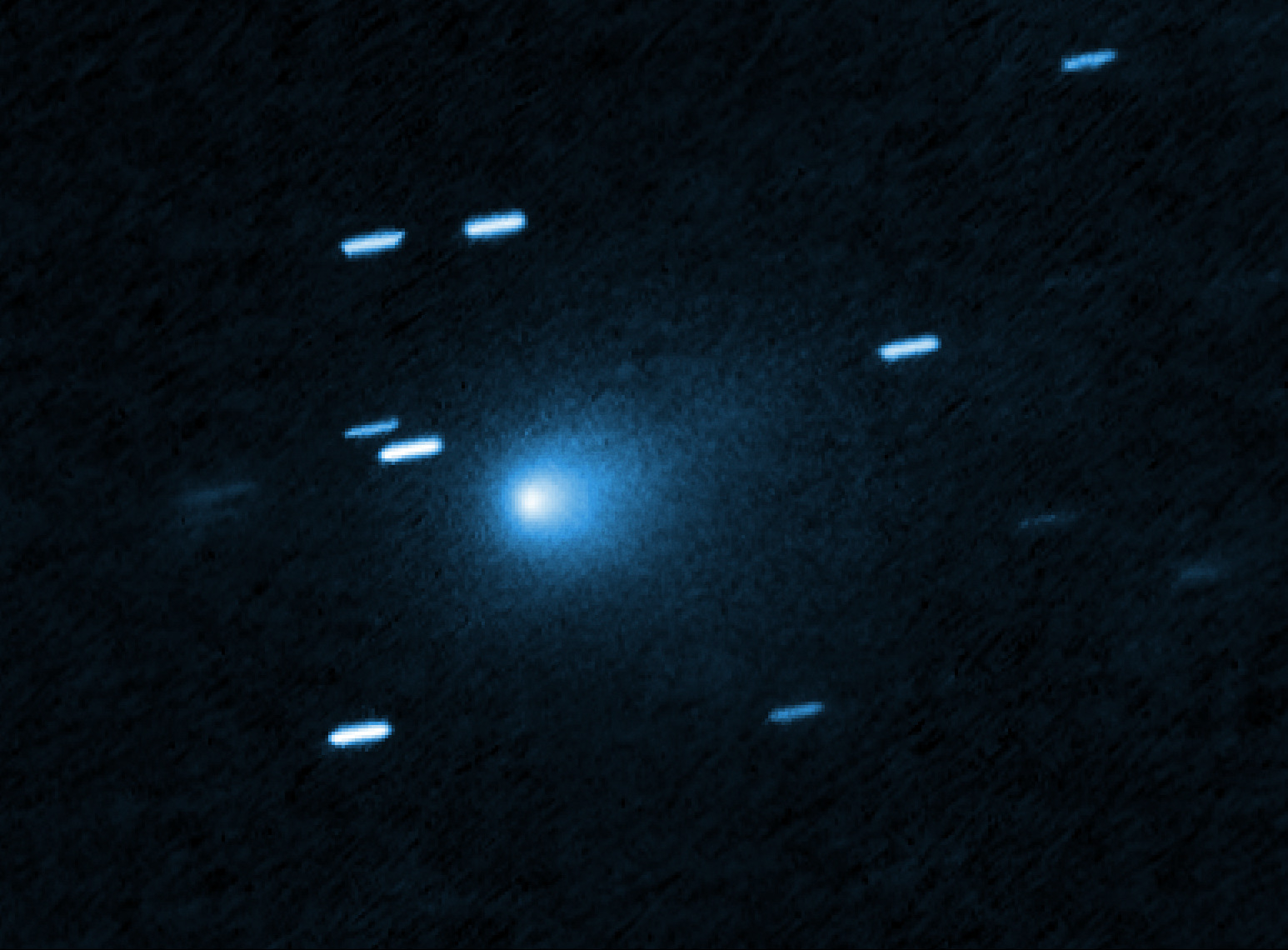
Discovered on July 1 with the NASA-funded ATLAS (Asteroid Terrestrial-impact Last Alert System) survey telescope in Rio Hurtado, Chile, 3I/ATLAS is so designated as the third known interstellar object to pass through our Solar System. It follows 1I/ʻOumuamua in 2017 and the comet 2I/Borisov in 2019. Also known as C/2025 N1, 3I/ATLAS is a comet. A teardrop-shaped cloud of dust, ejected from its icy nucleus warmed by increasing sunlight, is seen in this sharp image from the Hubble Space Telescope captured on July 21. Background stars are streaked in the exposure as Hubble tracked the fastest comet ever recorded on its journey toward the inner solar system. An analysis of the Hubble image indicates the solid nucleus, hidden from direct view, is likely less that 5.6 kilometers in diameter. This comet's interstellar origin is clear from its orbit, determined to be an eccentric, highly hyperbolic orbit that does not loop back around the Sun and will return 3I/ATLAS to interstellar space. Not a threat to planet Earth, the inbound interstellar interloper is now within the Jupiter's orbital distance of the Sun, while its closest approach to the Sun will bring it just inside the orbital distance of Mars.
Crédito: NASA, ATLAS, Hubble 3I/ATLAS fue descubierto el 1 de julio con el telescopio del sistema ATLAS (Asteroid Terrestrial-impact Last Alert System), financiado por la NASA, en Rio Hurtado, Chile. Se le designa así como el tercer objeto interestelar conocido que pasa por nuestro Sistema Solar. Le sigue 1I/ʻOumuamua de 2017 y el cometa 2I/Borisov de 2019. También conocido como C/2025 N1, 3I/ATLAS es un cometa. En esta imagen nítida del Telescopio Espacial Hubble, tomada el 21 de julio, se ve una nube en forma de lágrima de polvo, expulsada desde su núcleo helado, calentado por la luz solar cada vez más intensa. Las estrellas de fondo aparecen como rayas en la exposición, ya que el Hubble rastreó al cometa más rápido jamás registrado en su viaje hacia el interior del sistema solar. Un análisis de la imagen del Hubble indica que el núcleo sólido, oculto de la vista directa, probablemente tenga menos de 5,6 kilómetros de diámetro. El origen interestelar de este cometa es claro a partir de su órbita, determinada como excéntrica y altamente hiperbólica, que no vuelve a rodear al Sol y devolverá a 3I/ATLAS al espacio interestelar. No representa una amenaza para la Tierra, el visitante interestelar que llega ahora se encuentra dentro de la distancia orbital de Júpiter respecto al Sol, mientras que su acercamiento más cercano al Sol lo llevará justo dentro de la distancia orbital de Marte.