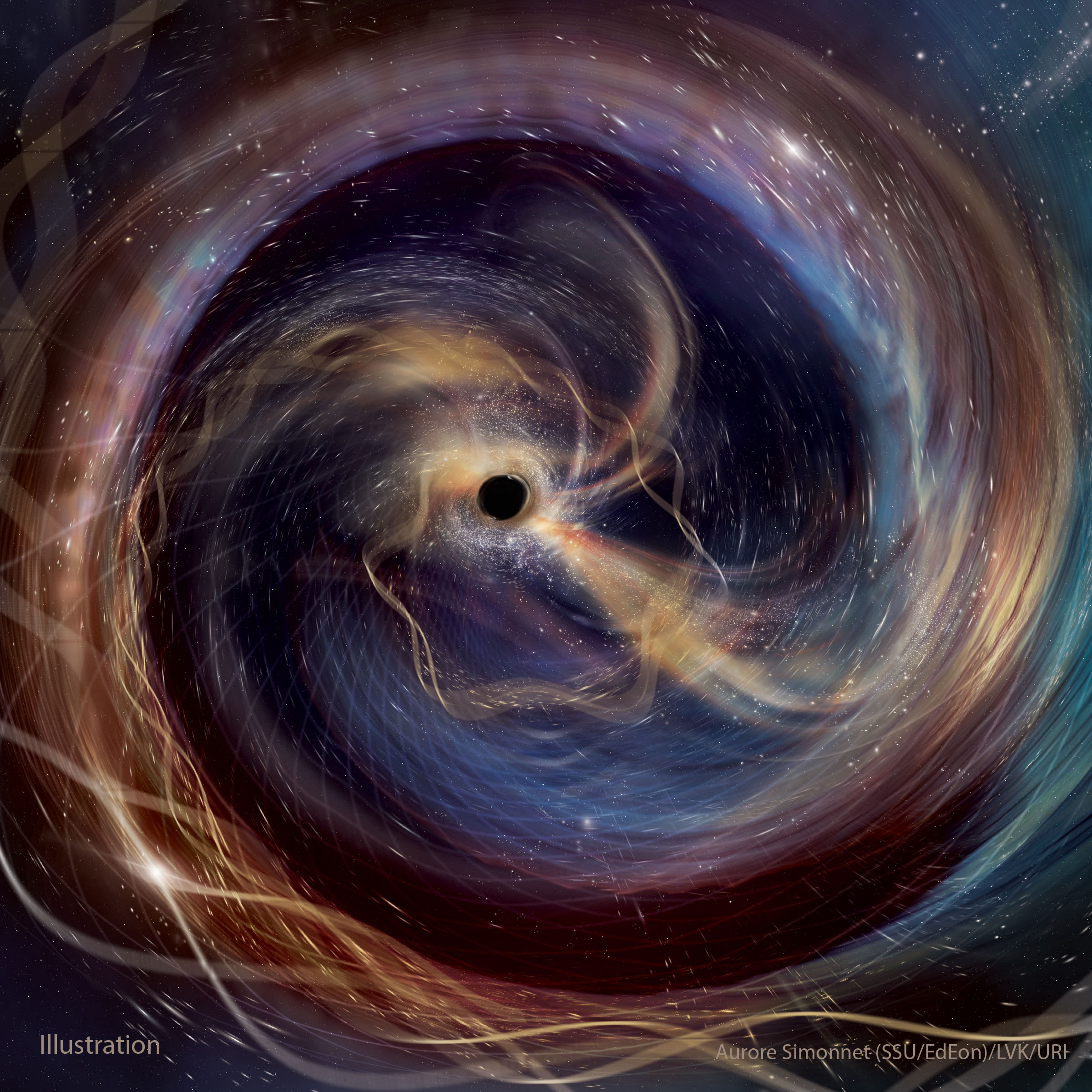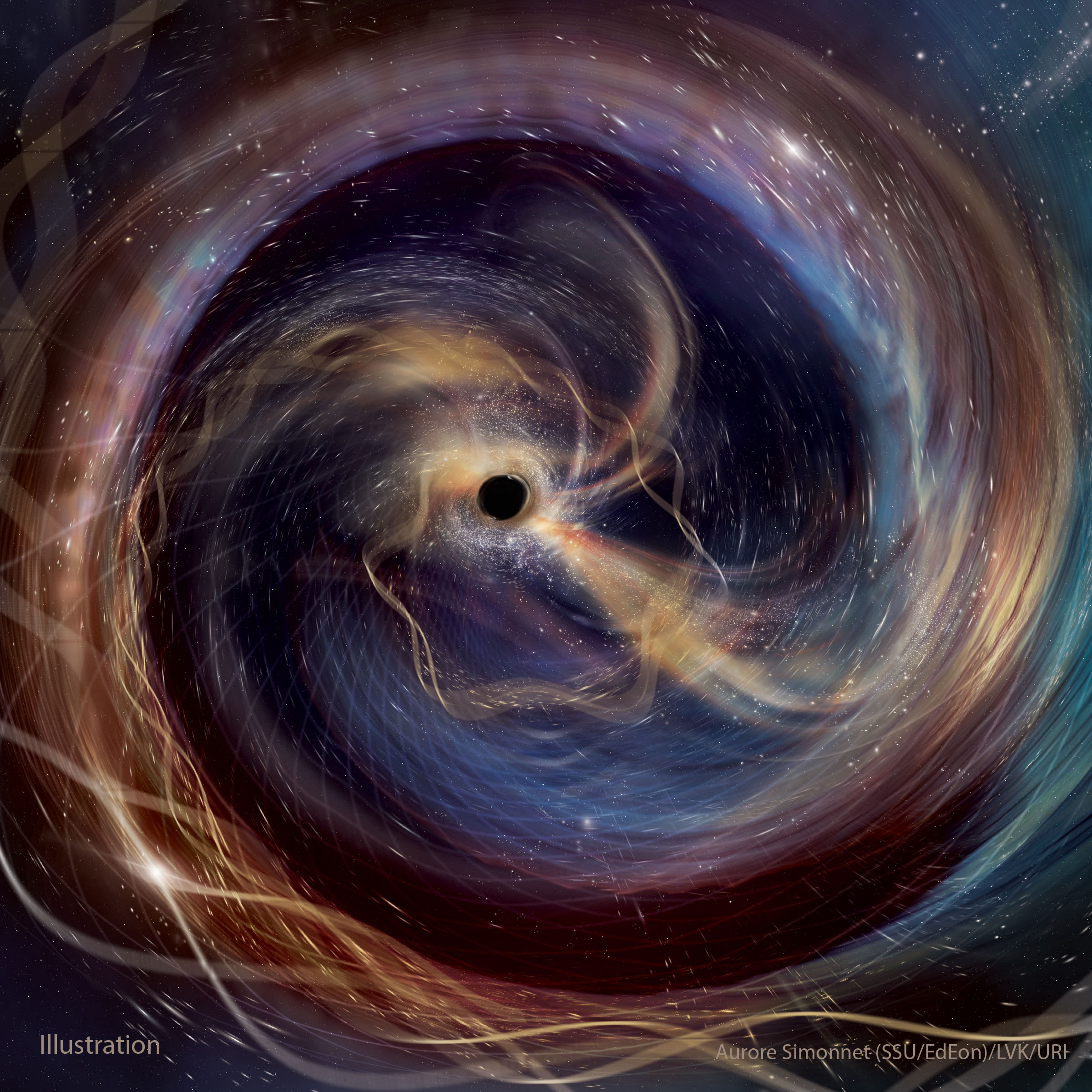
It was the strongest gravitational wave signal yet measured -- what did it show? GW250114 was detected by both arms of the Laser Interferometer Gravitational-wave Observatory (LIGO) in Washington and Louisiana USA earlier this year. Analysis showed that the event was created when two black holes, each of mass around 33 times the mass of the Sun, coalesced into one larger black hole with a mass of around 63 solar masses. Even though the event happened about a billion light years away, the signal was so strong that the spin of all black holes, as well as initial ringing of the final black hole, was deduced with exceptional accuracy. Furthermore, it was confirmed better than before, as previously predicted, that the total event horizon area of the combined black hole was greater than those of the merging black holes. Featured, an artist's illustration depicts an imaginative and conceptual view from near one of the black holes before collision.
Fue la señal más fuerte de ondas gravitacionales jamás medida — ¿qué mostró? GW250114 fue detectada por ambos brazos del Observatorio de Ondas Gravitacionales por Interferometría Láser (LIGO) en Washington y Louisiana, EE. UU., a principios de este año. El análisis mostró que el evento se creó cuando dos agujeros negros, cada uno con una masa aproximadamente 33 veces la del Sol, se fusionaron en un agujero negro más grande con una masa de alrededor de 63 masas solares. Aunque el evento ocurrió a unos mil millones de años luz de distancia, la señal fue tan fuerte que se dedujo con una precisión excepcional la rotación de todos los agujeros negros, así como el sonido inicial del agujero negro final. Además, se confirmó mejor que antes, como se había predicho anteriormente, que el área total del horizonte de sucesos del agujero negro combinado era mayor que la de los agujeros negros que se fusionaron. Se presenta una ilustración de un artista que muestra una visión imaginativa y conceptual desde cerca de uno de los agujeros negros antes de la colisión.