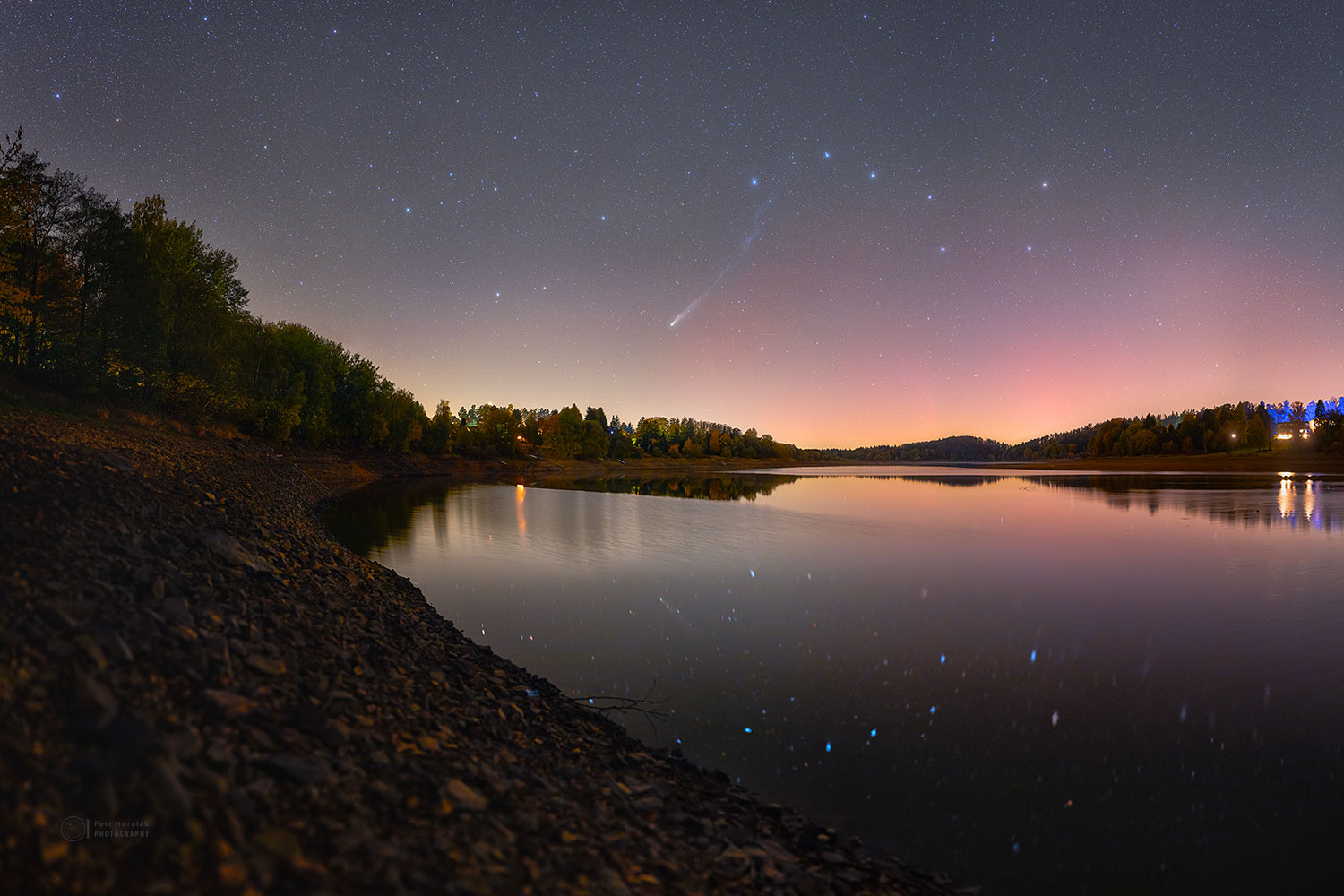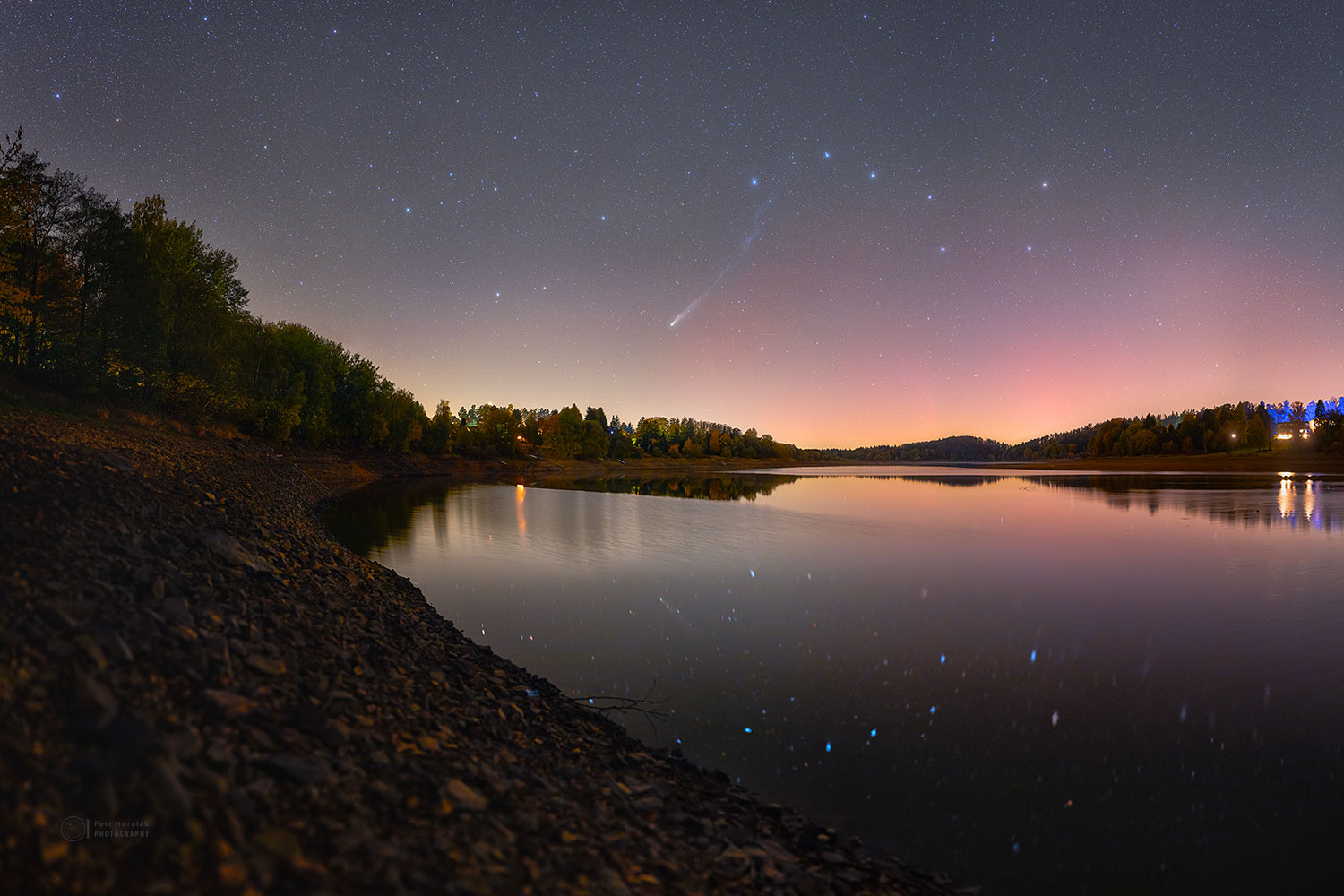
Tonight, if you can see the stars of the Big Dipper, then you can find comet Lemmon in your evening sky. After sunset, look for the faint but extended comet above your northwestern horizon -- but below the handle of the famous celestial kitchen utensil of the north. It might be easier to see this visitor to the inner Solar System through your camera phone, which is better at picking up faint objects. Either way, look for a fuzzy green 'star' with a tail, though probably not so long a tail as in this impressive snapshot taken over Seč Lake in the Czech Republic two nights ago. Recent photographs of C/2025 A6 (Lemmon) often show a detailed and changing ion tail which extends farther than the eye can follow. This Sun-orbiting comet is now near its closest approach to Earth and will pass its closest to the Sun in early November.
Esta noche, si puedes ver las estrellas de la Osa Mayor, entonces podrás encontrar el cometa Lemmon en tu cielo nocturno. Después de la puesta de sol, busca el tenue pero extendido cometa sobre tu horizonte noroeste, pero por debajo del mango de la famosa herramienta celeste del norte. Podría ser más fácil ver a este visitante del Sistema Solar interior a través de tu teléfono con cámara, que es mejor para captar objetos tenues. De cualquier manera, busca una estrella verde y borrosa con cola, aunque probablemente no tan larga como la que se muestra en esta impresionante fotografía tomada sobre el lago Seč en la República Checa hace dos noches. Las últimas fotografías de C/2025 A6 (Lemmon) suelen mostrar una cola iónica detallada y cambiante que se extiende más allá de lo que el ojo puede seguir. Este cometa que orbita al Sol ahora está cerca de su punto más cercano a la Tierra y pasará su punto más cercano al Sol a principios de noviembre.