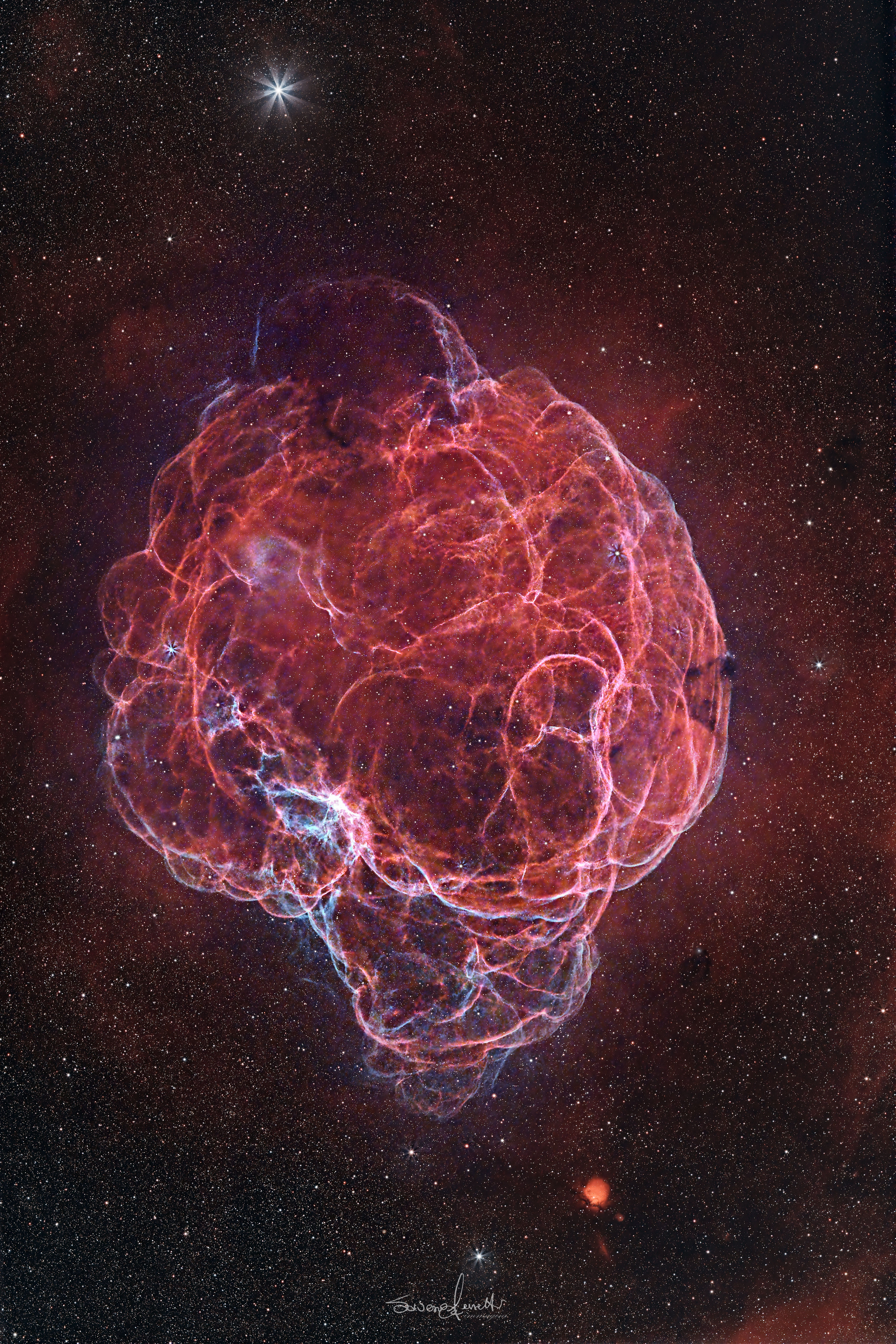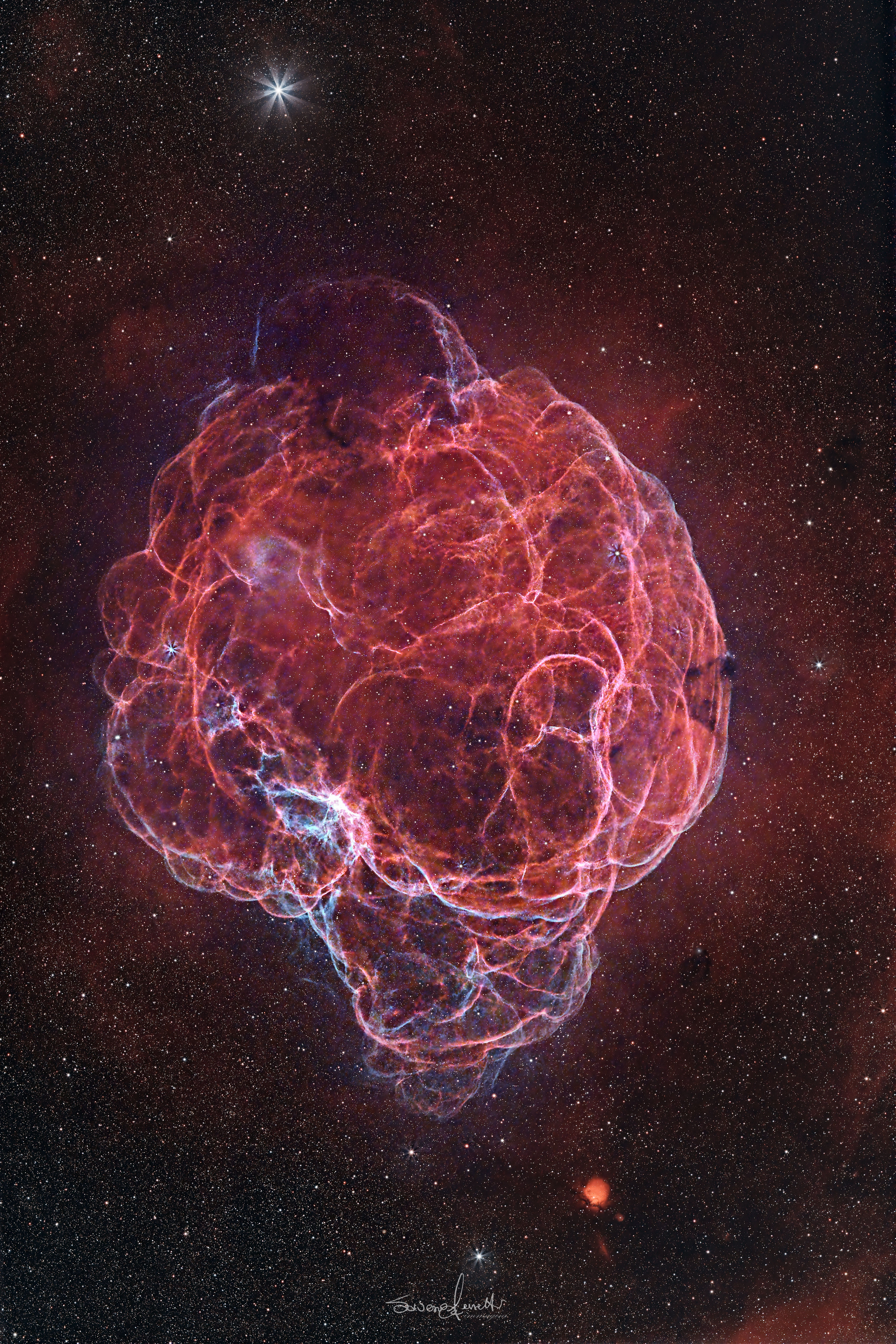
Its popular nickname is the Spaghetti Nebula. Officially cataloged as Simeis 147 and Sharpless 2-240, it is easy to get lost following the looping and twisting filaments of this intricate supernova remnant. Seen toward the boundary of the constellations of the Bull (Taurus) and the Charioteer (Auriga), the impressive gas structure covers nearly 3 degrees on the sky, equivalent to 6 full moons. That's about 150 light-years at the stellar debris cloud's estimated distance of 3,000 light-years. The supernova remnant has an estimated age of about 40,000 years, meaning light from this powerful stellar explosion first reached the Earth when woolly mammoths roamed free. Besides the expanding remnant, this cosmic catastrophe left behind a pulsar, a fast-spinning neutron star that is the remnant of the original star's core. The featured image was captured last month from Forca Canapine, Italy. Portal Universe: Random APOD Generator
Su popular apodo es la Nebulosa Espagueti. Catalogada oficialmente como Simeis 147 y Sharpless 2-240, es fácil perderse siguiendo los filamentos que se enroscan y entrelazan de este intrincado remanente de supernova. Observada hacia el límite de las constelaciones del Toro (Taurus) y el Auriga (Auriga), esta impresionante estructura gaseosa abarca casi 3 grados en el cielo, equivalente a 6 lunas llenas. Eso corresponde a unos 150 años luz, dado que la nube de restos estelares se encuentra a una distancia estimada de 3.000 años luz. El remanente de supernova tiene una edad estimada de aproximadamente 40.000 años, lo que significa que la luz de esta poderosa explosión estelar llegó por primera vez a la Tierra cuando los mamuts lanudos deambulaban libremente. Además del remanente en expansión, esta catástrofe cósmica dejó tras de sí un púlsar, una estrella de neutrones de rotación rápida que es el remanente del núcleo de la estrella original. La imagen destacada fue capturada el mes pasado desde Forca Canapine, Italia. Portal Universe: Random APOD Generator