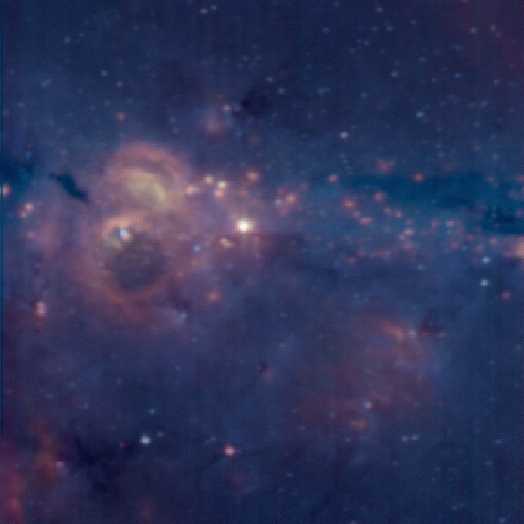
In Jules Verne's science fiction classic A Journey to the Center of the Earth, Professor Hardwigg and his fellow explorers encounter many strange and exciting wonders. What wonders lie at the center of our Galaxy? Astronomers now know of some of the bizarre objects which exist there, like vast dust clouds, bright young stars, swirling rings of gas, and even a large black hole. Much of the Galactic Center is shielded from our view in visible light by the intervening dust and gas, but it can be explored using other forms of electromagnetic radiation. This haunting image of the Galactic Center region in infrared light was made in 1996 by a telescope onboard the Midcourse Space Experiment. The center itself appears as a bright spot near the middle of this roughly 1 degree field of view, and the north galactic pole is towards the top. The picture is in false color - starlight appears blue while dust is greenish grey, tending to red in the cooler areas.
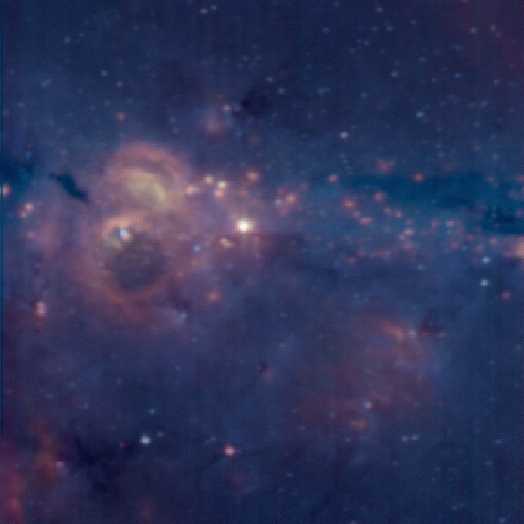
En la clásica novela de ciencia ficción de Julio Verne, Viaje al centro de la Tierra, el Profesor Hardwigg y sus compañeros exploradores se encuentran con numerosas maravillas extrañas y fascinantes. ¿Qué maravillas yacen en el centro de nuestra Galaxia? Los astrónomos conocen ahora algunos de los objetos bizarros que existen allí, como vastas nubes de polvo, jóvenes estrellas brillantes, anillos de gas en remolino e incluso un gran agujero negro. Gran parte del Centro Galáctico está bloqueada a nuestra vista en luz visible por el polvo y el gas interpuestos, pero puede explorarse utilizando otras formas de radiación electromagnética. Esta inquietante imagen de la región del Centro Galáctico en luz infrarroja fue tomada en 1996 por un telescopio a bordo del Midcourse Space Experiment. El centro mismo aparece como un punto brillante cerca del medio de este campo de visión de aproximadamente 1 grado, y el polo galáctico norte se encuentra hacia la parte superior. La imagen está en falso color: la luz estelar aparece en azul, mientras que el polvo es de un gris verdoso que tiende al rojo en las zonas más frías.