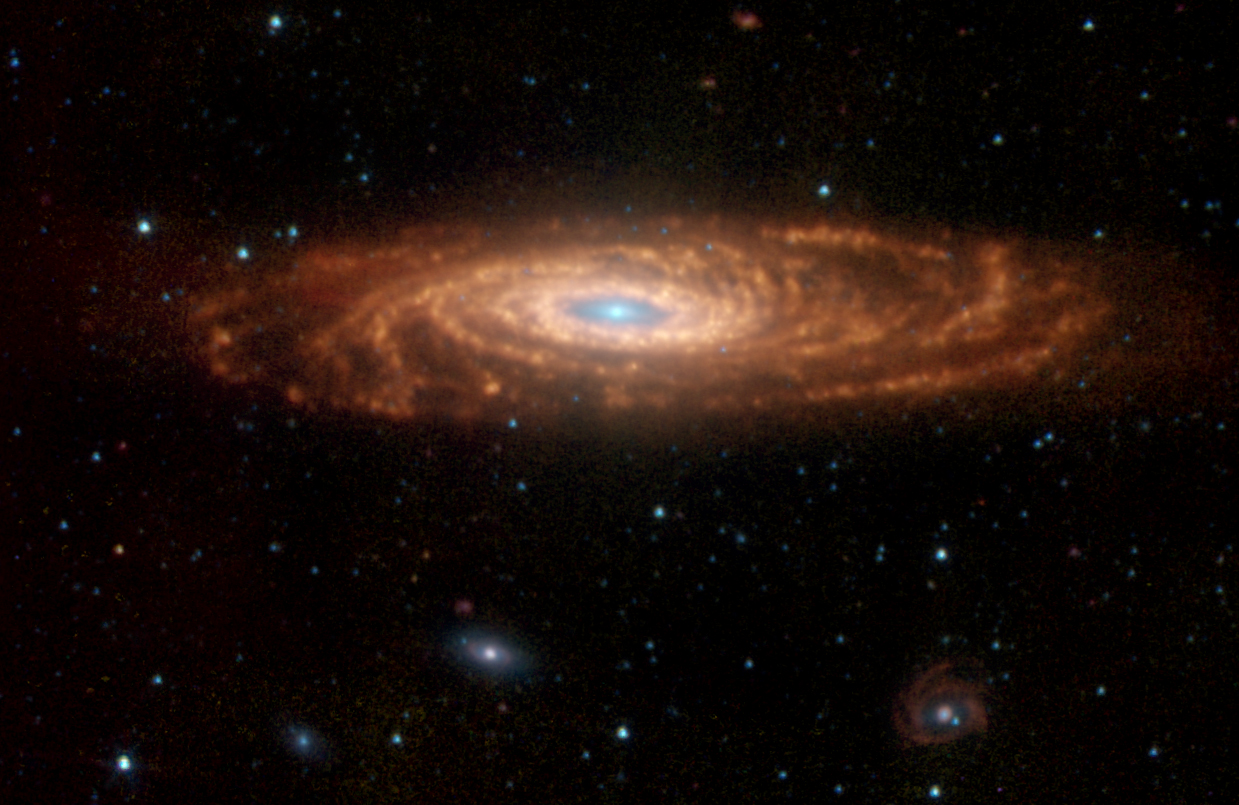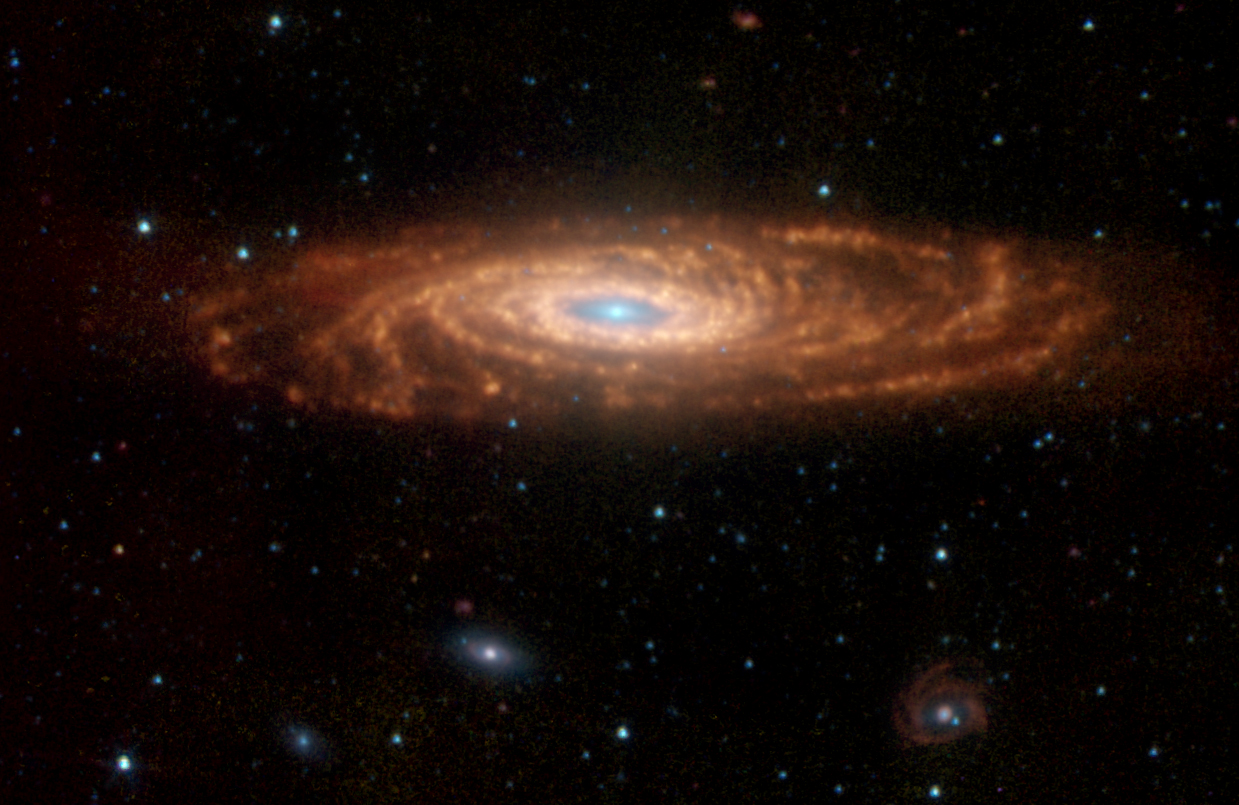
If our own Milky Way galaxy were 50 million light-years away with its disk inclined slightly to our line of sight, it would look a lot like large spiral galaxy NGC 7331. In fact, seen here in a false-color infrared image from the Spitzer Space Telescope, NGC 7331 is interesting in part because it is thought to be so similar to the Milky Way. Light from older, cooler stars, shown in blue, dominates the central bulge of NGC 7331, while Spitzer data also indicates the presence of a black hole within this galaxy's central regions - about the same size as the black hole at our own galactic core. Shown in red and brown, radiation from complex molecules associated with dust traces NGC 7331's star forming spiral arms. The arms span around 100,000 light-years, about the size of the Milky Way. Curiously, a further star forming ring is visible in yellowish hues, 20,000 light-years or so from the center of NGC 7331, but it is not known if such a structure exists within our own galaxy.
Si nuestra propia galaxia Vía Láctea estuviera a 50 millones de años luz de distancia con su disco ligeramente inclinado respecto a nuestra línea de visión, se parecería mucho a la gran galaxia espiral NGC 7331. De hecho, tal como se ve aquí en una imagen infrarroja de falso color del Telescopio Espacial Spitzer, NGC 7331 es interesante en parte porque se cree que es muy similar a la Vía Láctea. La luz de estrellas más antiguas y frías, mostradas en azul, domina el bulbo central de NGC 7331, mientras que los datos de Spitzer también indican la presencia de un agujero negro dentro de las regiones centrales de esta galaxia, aproximadamente del mismo tamaño que el agujero negro en nuestro núcleo galáctico. Mostrados en rojo y marrón, la radiación de moléculas complejas asociadas con el polvo traza los brazos espirales formadores de estrellas de NGC 7331. Los brazos abarcan alrededor de 100,000 años luz, aproximadamente del tamaño de la Vía Láctea. Curiosamente, se puede ver un anillo adicional de formación estelar en tonos amarillentos, a unos 20,000 años luz del centro de NGC 7331, pero se desconoce si tal estructura existe dentro de nuestra propia galaxia.