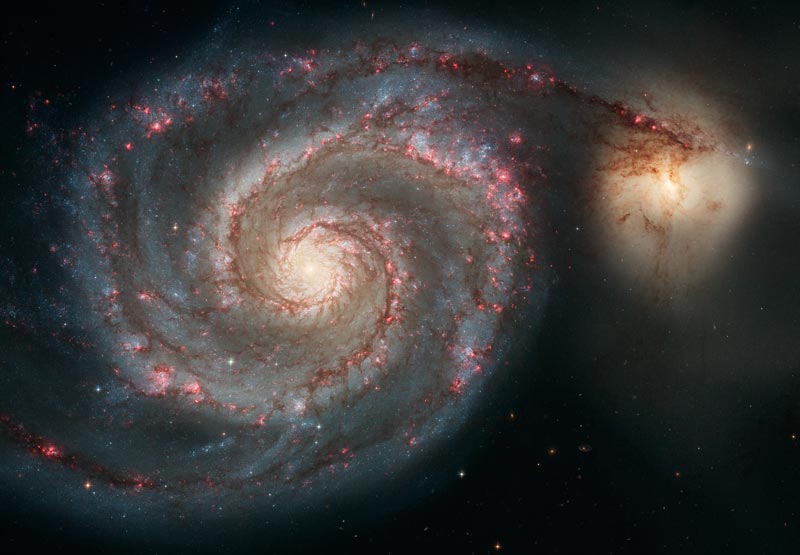
Follow the handle of the Big Dipper away from the dipper's bowl, until you get to the handle's last bright star. Then, just slide your telescope a little south and west and you might find this stunning pair of interacting galaxies, the 51st entry in Charles Messier's famous catalog. Perhaps the original spiral nebula, the large galaxy with well defined spiral structure is also cataloged as NGC 5194. Its spiral arms and dust lanes clearly sweep in front of its companion galaxy (right), NGC 5195. The pair are about 31 million light-years distant and officially lie within the boundaries of the small constellation Canes Venatici. Though M51 looks faint and fuzzy in small, earthbound telescopes, this sharpest ever picture of M51 was made in January 2005 with the Advanced Camera for Surveys on board the Hubble Space Telescope.
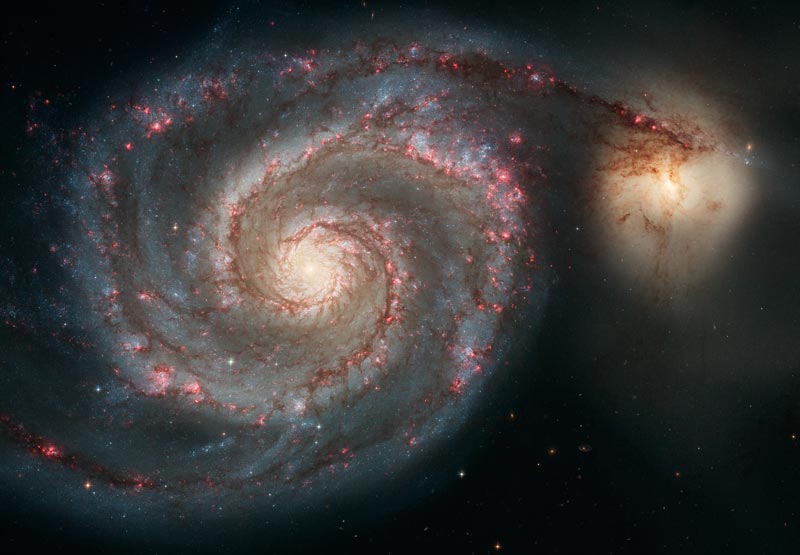
Sigue el mango de la Osa Mayor alejándote del cuenco de la constelación, hasta llegar a la última estrella brillante del mango. Luego, desliza tu telescopio un poco hacia el sur y el oeste y podrías encontrar este par impresionante de galaxias que interactúan, la entrada número 51 en el famoso catálogo de Charles Messier. Posiblemente la nebulosa espiral original, la galaxia grande con estructura espiral bien definida también se cataloga como NGC 5194. Sus brazos espirales y bandas de polvo barren claramente por delante de su galaxia compañera (a la derecha), NGC 5195. El par se encuentra a aproximadamente 31 millones de años luz de distancia y oficialmente se encuentra dentro de los límites de la pequeña constelación Canes Venatici. Aunque M51 se ve débil y borrosa en telescopios pequeños terrestres, esta fotografía más nítida jamás tomada de M51 fue realizada en enero de 2005 con la Cámara Avanzada para Inspecciones a bordo del Telescopio Espacial Hubble.