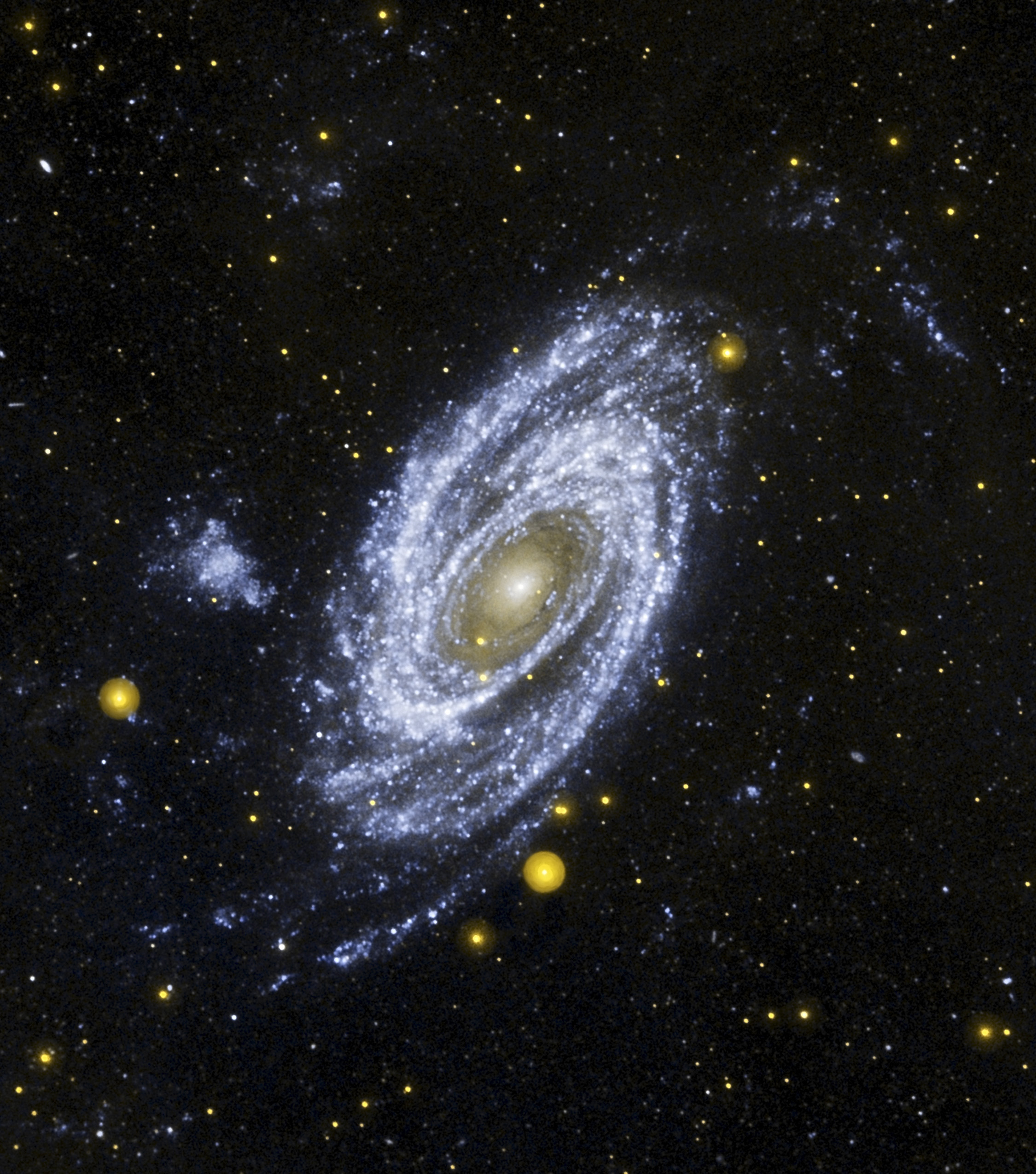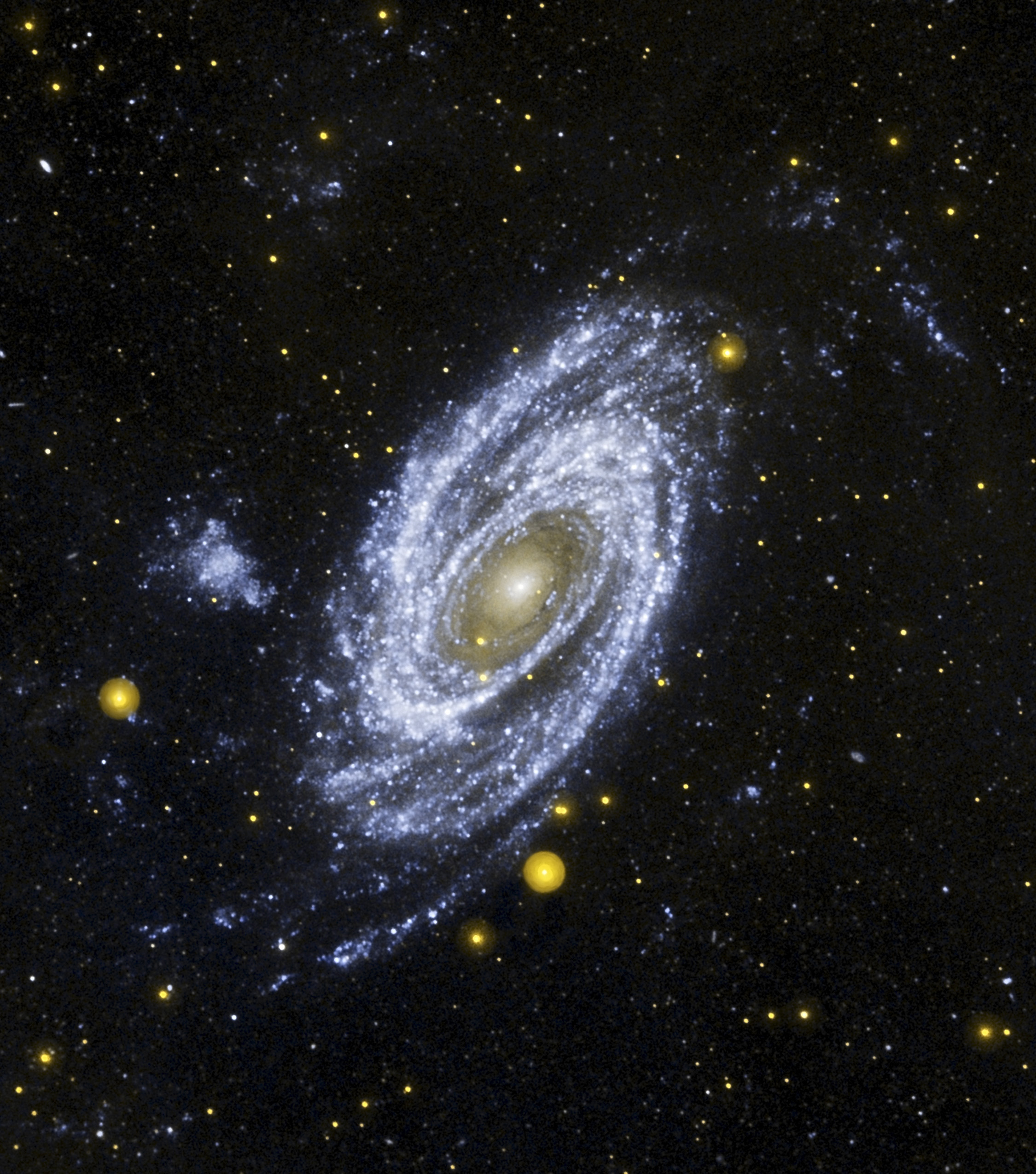
Where are the hot stars in M81, one of the closest major spiral galaxies? To help find out, astronomers took a deep image in ultraviolet light of the sprawling spiral with the Earth-orbiting Galex telescope. Hot stars emit more ultraviolet than cool stars, and are frequently associated with young open clusters of stars and energetic star forming regions. Magnificent spiral galaxy M81, slightly smaller in size to our own Milky Way Galaxy, shows off its young stars in its winding spiral arms in the above image. Less than 100 million years old, the young stars are blue in the above false-color Galex image and seen to be well separated from the older yellowish stars of the galactic core. Visible above M81 is a satellite galaxy dubbed Holmberg IX. Studying the unexpectedly bright ultraviolet glow of this small irregular galaxy may help astronomers understand how the many satellites of our own Milky Way Galaxy developed. M81, visible through a small telescope, spans about 70,000 light years and lies about 12 million light years away toward the constellation of the Great Bear (Ursa Major).
¿Dónde se encuentran las estrellas calientes en M81, una de las mayores galaxias espirales más cercanas a nosotros? Para ayudar a determinarlo, los astrónomos obtuvieron una imagen profunda en luz ultravioleta de esta amplia espiral con el telescopio espacial Galex. Las estrellas calientes emiten más radiación ultravioleta que las estrellas frías y frecuentemente están asociadas con cúmulos abiertos jóvenes de estrellas y regiones de formación estelar energéticas. La magnífica galaxia espiral M81, ligeramente más pequeña que nuestra propia Vía Láctea, exhibe sus estrellas jóvenes en sus brazos espirales sinuosos en la imagen anterior. Con menos de 100 millones de años de edad, las estrellas jóvenes aparecen de color azul en la imagen en falso color de Galex y se observan bien separadas de las estrellas más antiguas de color amarillento del núcleo galáctico. Visible sobre M81 hay una galaxia satélite llamada Holmberg IX. El estudio del resplandor ultravioleta inesperadamente brillante de esta pequeña galaxia irregular puede ayudar a los astrónomos a comprender cómo se desarrollaron los numerosos satélites de nuestra propia Vía Láctea. M81, visible a través de un pequeño telescopio, abarca aproximadamente 70,000 años luz y se encuentra a unos 12 millones de años luz de distancia hacia la constelación de la Osa Mayor (Ursa Major).