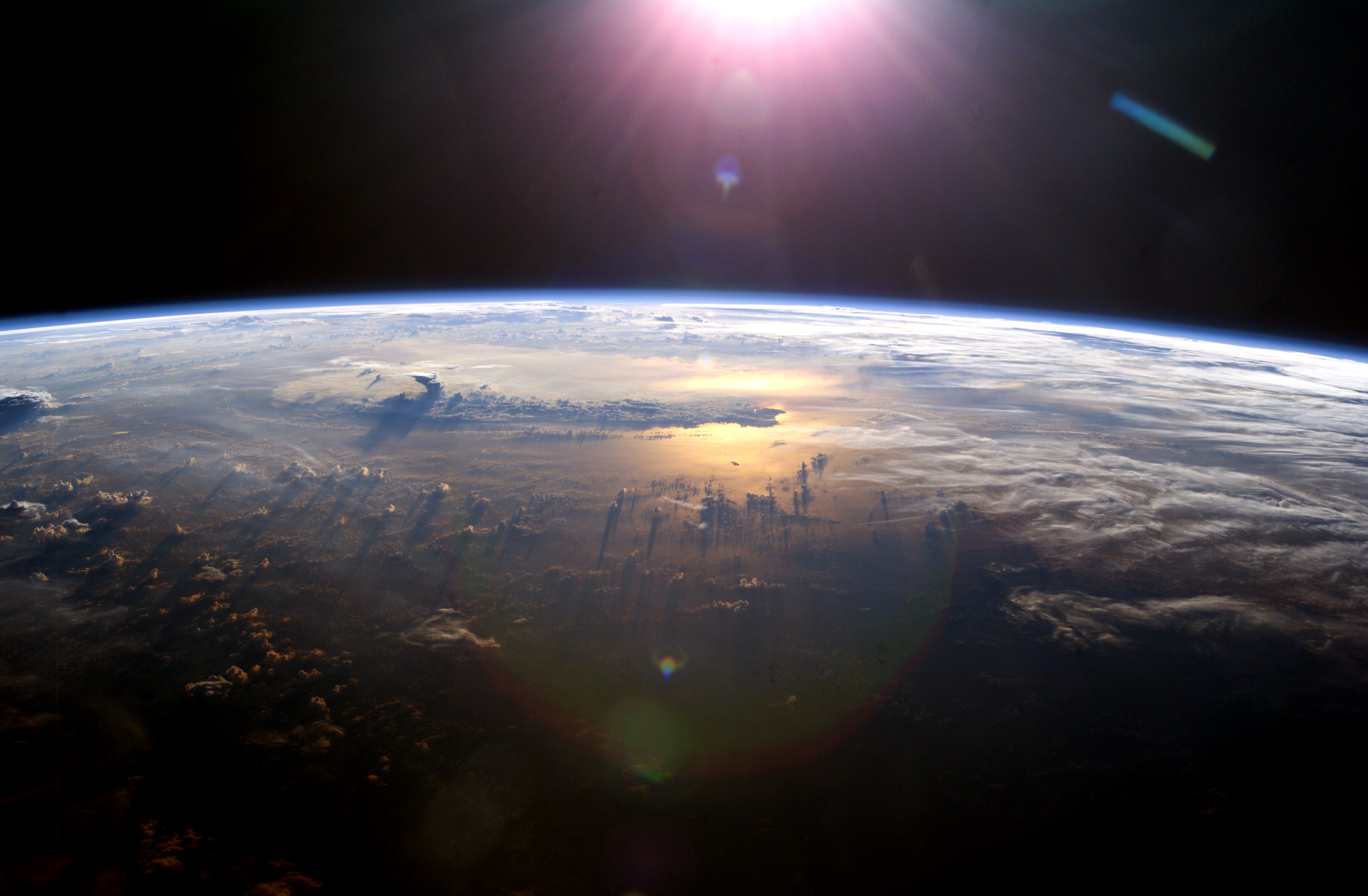
On April 12th, 1961, Soviet cosmonaut Yuri Alexseyevich Gagarin became the first human in space. His remotely controlled Vostok 1 spacecraft lofted him to an altitude of 200 miles and carried him once around planet Earth. Commenting on the first view from space he reported, "The sky is very dark; the Earth is bluish. Everything is seen very clearly". Alan Shepard, the first US astronaut, would not be launched until almost a month later and then on a comparatively short suborbital flight. Born on March 9, 1934, Gagarin was a military pilot before being chosen for the first group of cosmonauts in 1960. As a result of his historic flight he became an international hero and legend. Killed when his MIG jet crashed during a training flight on March 27, 1968, Gagarin was given a hero's funeral, his ashes interred in the Kremlin Wall. On yet another April 12th, in 1981, NASA launched the first space shuttle.
El 12 de abril de 1961, el cosmonauta soviético Yuri Alexseyevich Gagarin se convirtió en el primer ser humano en el espacio. Su nave Vostok 1, controlada remotamente, lo llevó a una altitud de 200 millas y lo trasladó una vez alrededor del planeta Tierra. Comentando sobre la primera vista desde el espacio, reportó: "El cielo es muy oscuro; la Tierra es azulada. Todo se ve muy claramente". Alan Shepard, el primer astronauta estadounidense, no sería lanzado hasta casi un mes después y en un vuelo suborbital comparativamente corto. Nacido el 9 de marzo de 1934, Gagarin era piloto militar antes de ser elegido para el primer grupo de cosmonautas en 1960. Como resultado de su vuelo histórico, se convirtió en un héroe internacional y una leyenda. Muerto cuando su avión MIG se estrelló durante un vuelo de entrenamiento el 27 de marzo de 1968, Gagarin recibió un funeral de héroe, sus cenizas depositadas en la Muralla del Kremlin. En otro 12 de abril, en 1981, la NASA lanzó el primer transbordador espacial.