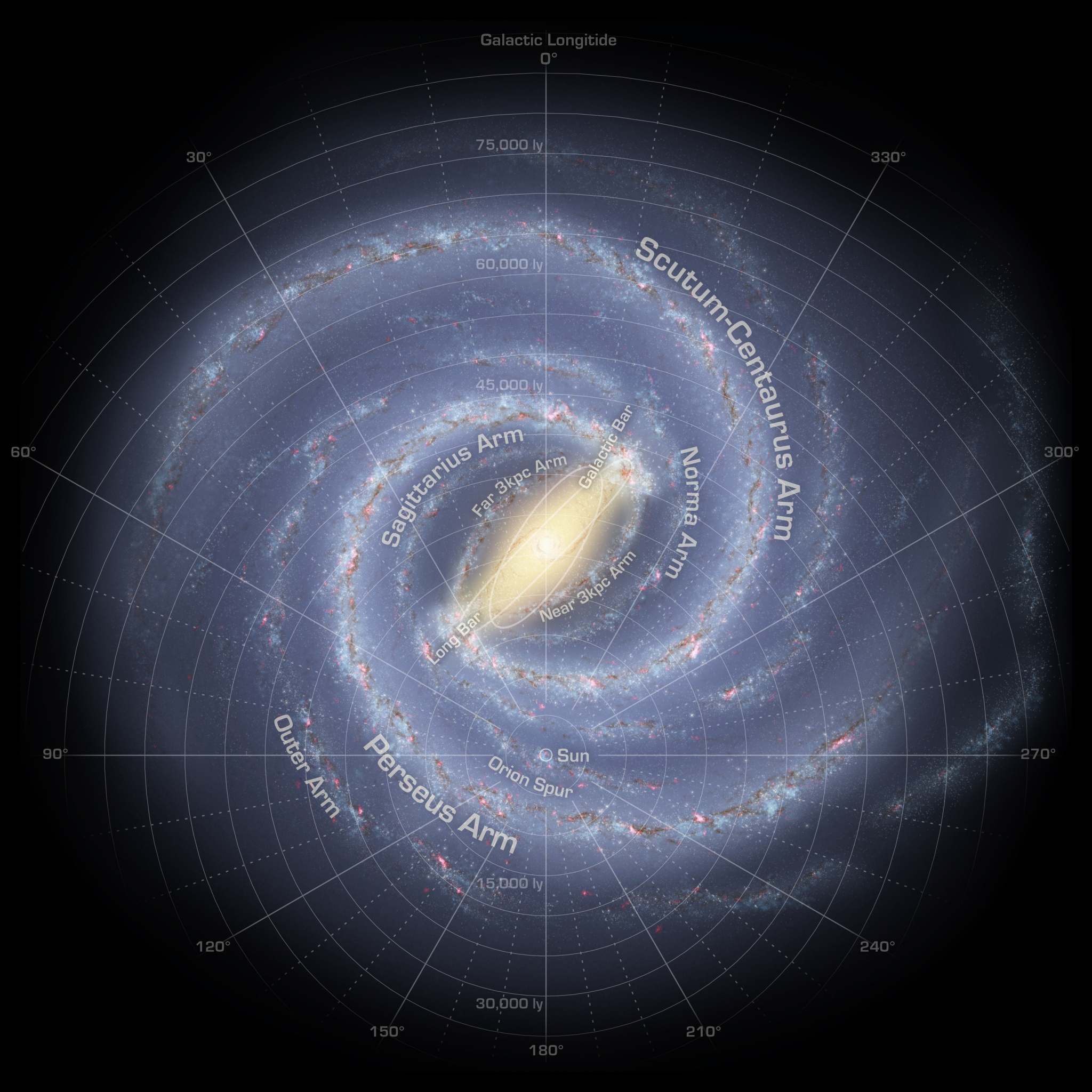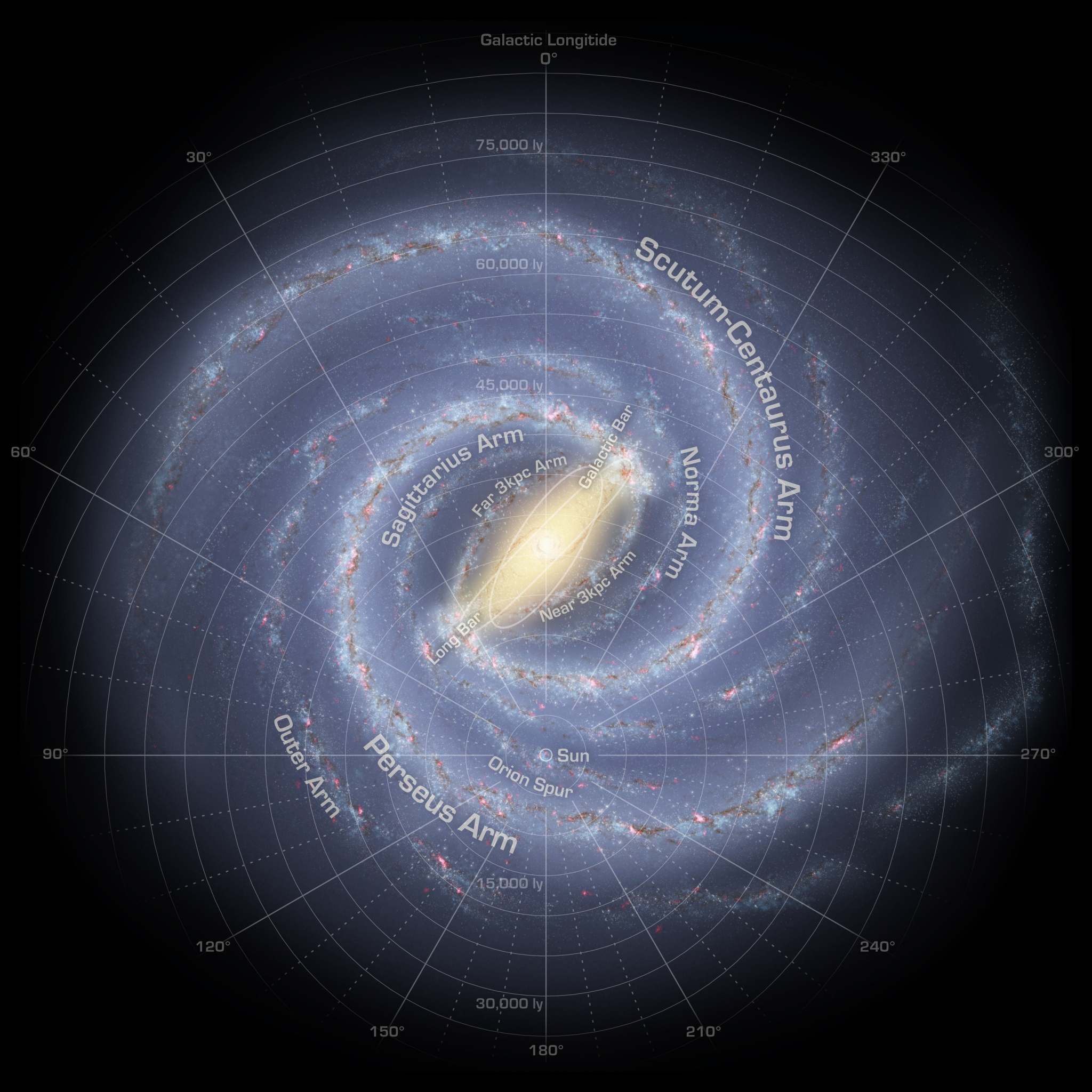
Gazing out from within the Milky Way, our own galaxy's true structure is difficult to discern. But an ambitious survey effort with the Spitzer Space Telescope now offers convincing evidence that we live in a large galaxy distinguished by two main spiral arms (the Scutum-Centaurus and Perseus arms) emerging from the ends of a large central bar. In fact, from a vantage point that viewed our galaxy face-on, astronomers in distant galaxies would likely see the Milky Way as a two-armed barred spiral similar to this artist's illustration. Previous investigations have identified a smaller central barred structure and four spiral arms. Astronomers still place the Sun about a third of the way in from the Milky Way's outer edge, in a minor arm called the Orion Spur. To locate the Sun and identify the Milky Way's newly mapped features, just place your cursor over the image.
Observando desde el interior de la Vía Láctea, la verdadera estructura de nuestra propia galaxia es difícil de discernir. Sin embargo, un ambicioso esfuerzo de observación con el Telescopio Espacial Spitzer ahora ofrece evidencia convincente de que vivimos en una galaxia grande distinguida por dos brazos espirales principales (los brazos Scutum-Centaurus y Perseus) que emergen de los extremos de una gran barra central. De hecho, desde un punto de vista que observara nuestra galaxia de frente, los astrónomos en galaxias distantes probablemente verían la Vía Láctea como una espiral barrada de dos brazos similar a esta ilustración de un artista. Investigaciones previas han identificado una estructura barrada central más pequeña y cuatro brazos espirales. Los astrónomos aún ubican al Sol aproximadamente a un tercio de distancia desde el borde exterior de la Vía Láctea, en un brazo menor llamado el Espolón de Orión. Para localizar el Sol e identificar las características recién mapeadas de la Vía Láctea, simplemente coloque el cursor sobre la imagen.