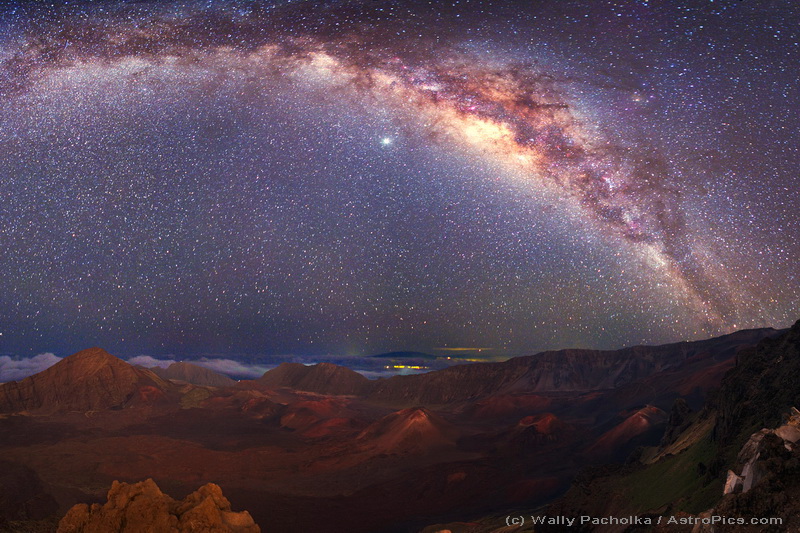
Have you ever seen the band of our Milky Way Galaxy? In a clear sky from a dark location at the right time, a faint band of light becomes visible across the sky. Soon after your eyes become dark adapted, you might spot the band for the first time. It may then become obvious. Then spectacular. One reason for a growing astonishment might be the realization that this fuzzy swath contains billions of stars and is the disk of our very own spiral galaxy. Since we are inside this disk, the band appears to encircle the Earth. Visible in the above image, high above in the night sky, the band of the Milky Way Galaxy arcs. The bright spot just below the band is the planet Jupiter. In the foreground lies the moonlit caldera of the volcano Haleakala, located on the island of Maui in Hawaii, USA. A close look near the horizon will reveal light clouds and the dark but enormous Mauna Kea volcano on the Big Island of Hawaii. If you have never seen the Milky Way band or recognized the planet Jupiter, this year may be your chance. Because 2009 is the International Year of Astronomy, an opportunity to look through a window that peers deep into the universe may be coming to a location near you.
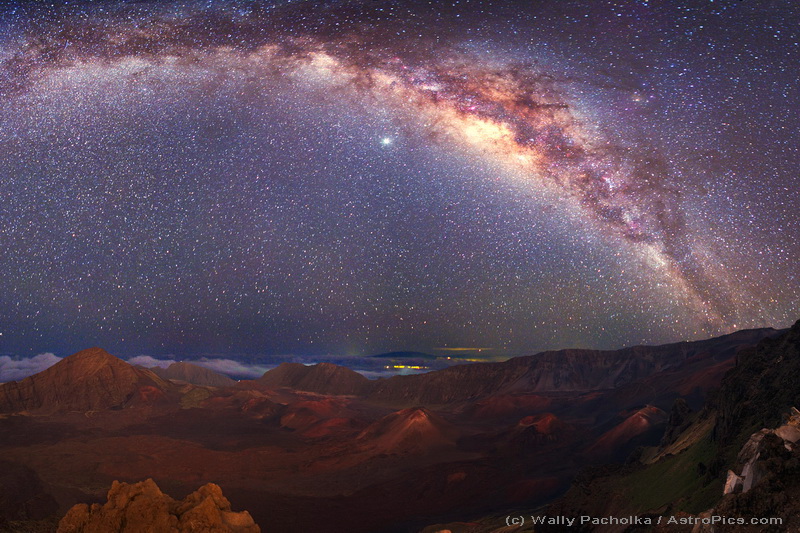
¿Ha visto alguna vez la banda de nuestra Galaxia de la Vía Láctea? En un cielo despejado desde una ubicación oscura y en el momento adecuado, una débil banda de luz se hace visible a través del cielo. Poco después de que los ojos se adapten a la oscuridad, podría avistar la banda por primera vez. Puede volverse entonces evidente. Luego espectacular. Una razón para el creciente asombro podría ser la realización de que este difuso trazo contiene miles de millones de estrellas y es el disco de nuestra propia galaxia espiral. Como estamos dentro de este disco, la banda parece rodear la Tierra. Visible en la imagen superior, muy arriba en el cielo nocturno, la banda de la Galaxia de la Vía Láctea se arquea. El punto brillante justo debajo de la banda es el planeta Júpiter. En primer plano se encuentra la caldera iluminada por la luna del volcán Haleakalá, ubicado en la isla de Maui en Hawái, EE.UU. Una observación cuidadosa cerca del horizonte revelará nubes de luz y el oscuro pero enorme volcán Mauna Kea en la Isla Grande de Hawái. Si nunca ha visto la banda de la Vía Láctea o reconocido el planeta Júpiter, este año puede ser su oportunidad. Debido a que 2009 es el Año Internacional de la Astronomía, una oportunidad de mirar a través de una ventana que se asoma profundamente al universo puede estar llegando a una ubicación cerca de usted.