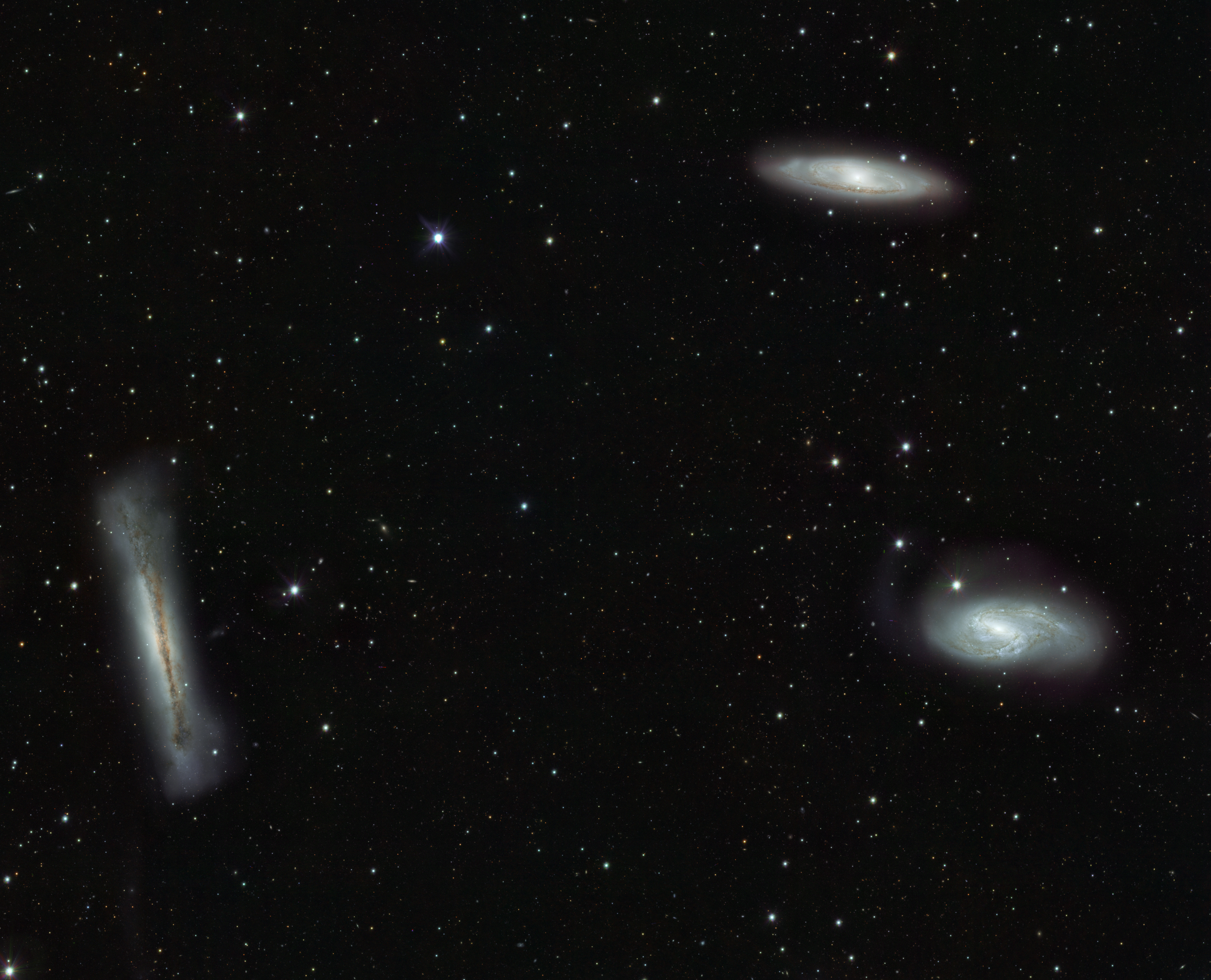
This popular group is famous as the Leo Triplet - a gathering of three magnificent galaxies in one field of view. Crowd pleasers when imaged with even modest telescopes, these galaxies can be introduced individually as NGC 3628 (left), M66 (bottom right), and M65 (top right). All three are large spiral galaxies. They tend to look dissimilar because their galactic disks are tilted at different angles to our line of sight. NGC 3628 is seen edge-on, with obscuring dust lanes cutting across the plane of the galaxy, while the disks of M66 and M65 are both inclined enough to show off their spiral structure. Gravitational interactions between galaxies in the group have also left telltale signs, including the warped and inflated disk of NGC 3628 and the drawn out spiral arms of M66. This gorgeous deep view of the region was taken by the new VLT Survey Telescope (VST) and spans about one degree (two full moons) on the sky. The field covers over 500 thousand light-years at the trio's estimated distance of 30 million light-years.
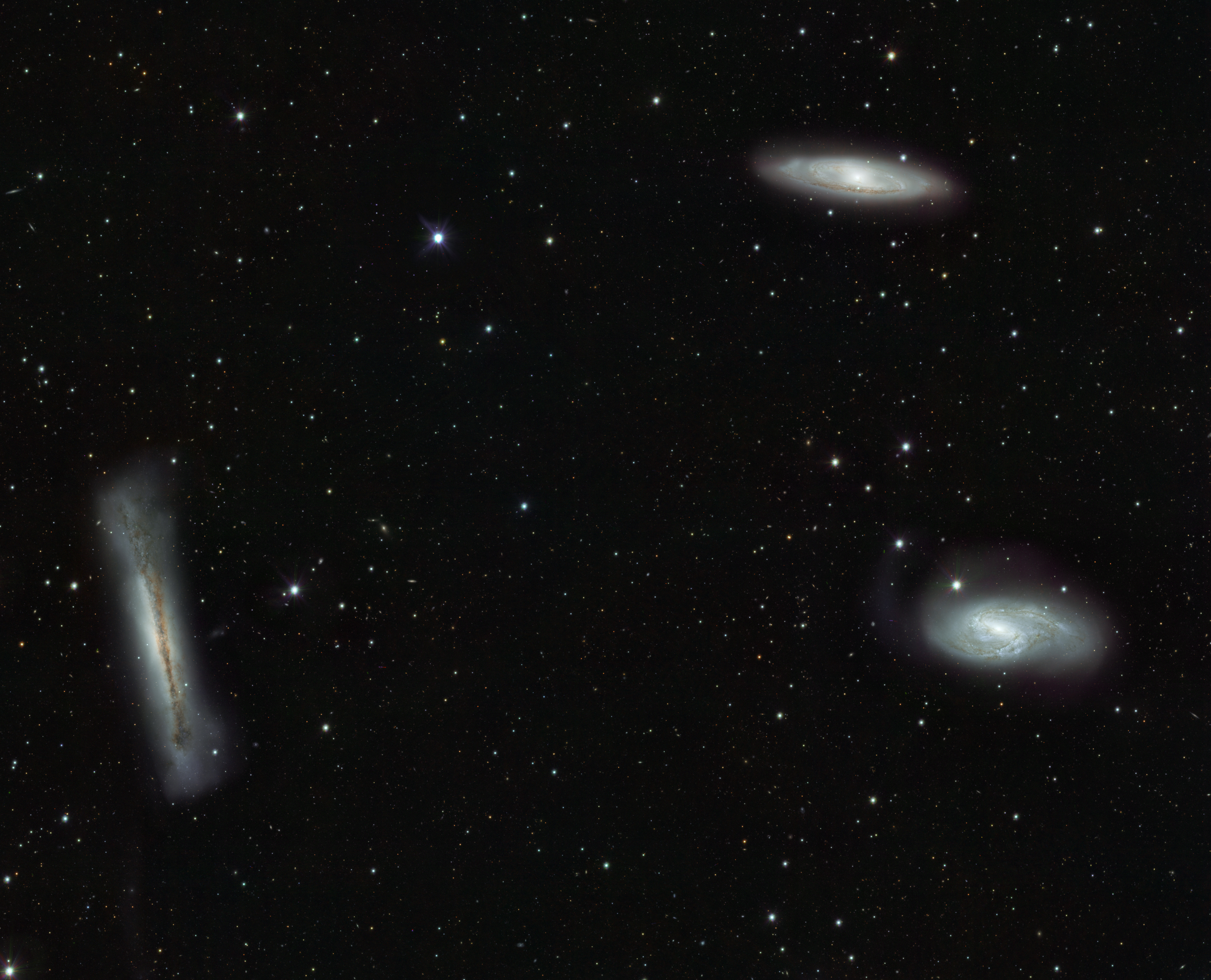
Este popular grupo es conocido como el Trío de Leo: una reunión de tres magníficas galaxias en un solo campo de visión. Auténticas joyas para observar incluso con telescopios modestos, estas galaxias pueden presentarse individualmente como NGC 3628 (izquierda), M66 (inferior derecha) y M65 (superior derecha). Las tres son grandes galaxias espirales. Presentan apariencias distintas porque sus discos galácticos están inclinados en diferentes ángulos respecto a nuestra línea de visión. NGC 3628 se observa de canto, con bandas de polvo oscuro que atraviesan el plano de la galaxia, mientras que los discos de M66 y M65 están lo suficientemente inclinados como para mostrar su estructura espiral. Las interacciones gravitacionales entre las galaxias del grupo también han dejado señales reveladoras, incluyendo el disco deformado e inflado de NGC 3628 y los brazos espirales elongados de M66. Esta magnífica vista profunda de la región fue tomada por el nuevo VLT Survey Telescope (VST) y abarca aproximadamente un grado (dos lunas llenas) en el cielo. El campo cubre más de 500 000 años-luz a la distancia estimada del trío de 30 millones de años-luz.