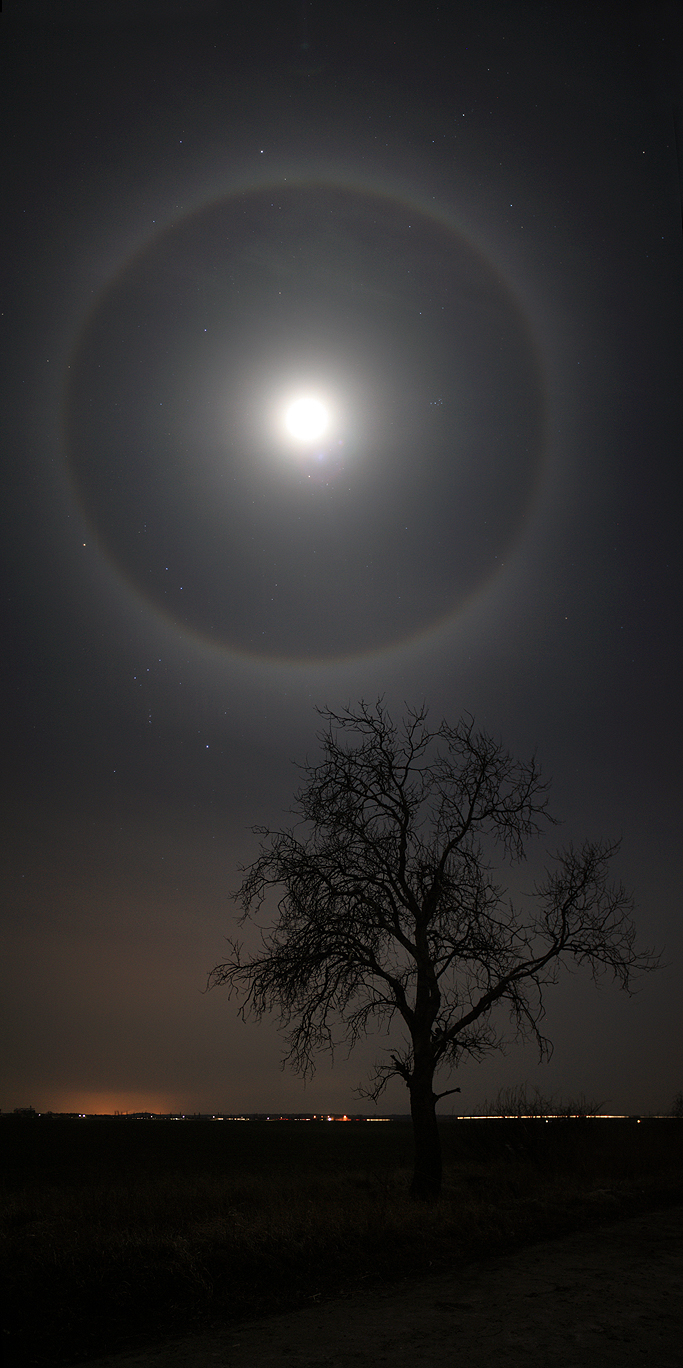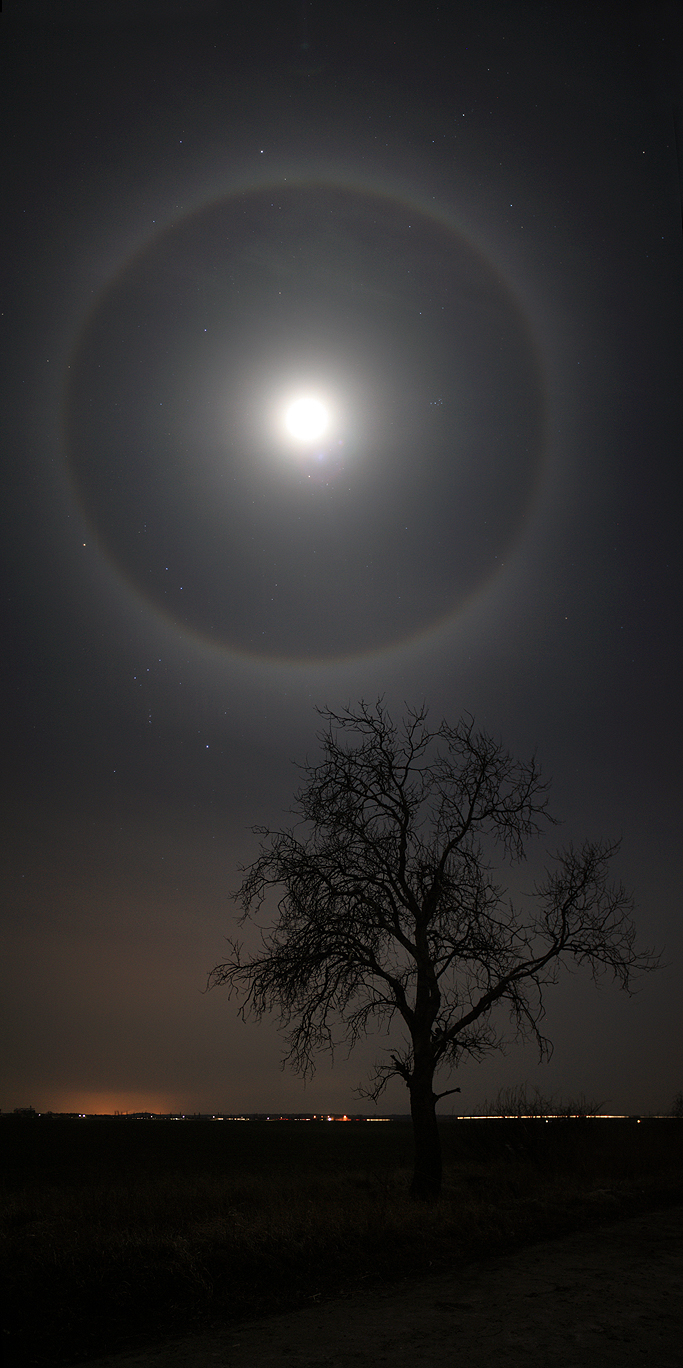
Lighting the night last Tuesday, February's Full Moon is sometimes called the Snow Moon. But the Moon was not quite full in this mosaicked skyscape recorded on February 2 south of Budapest, Hungary, and there was no snow either. Still, thin clouds of ice crystals hung in the cold, wintry sky creating this gorgeous lunar halo. Refraction of moonlight by the six-sided crystals produce the slightly colored halo with its characteristic radius of 22 degrees. Just below the Moon is bright star Aldebaran. Also well within the halo at the right is the Pleiades star cluster. At the lower left, near the halo's edge lie the stars of Orion with bright Capella, alpha star of the constellation Auriga, just beyond the halo near the top of the frame.
Iluminando la noche el pasado martes, la Luna llena de febrero es conocida en ocasiones como la Luna de Nieve. Sin embargo, la Luna no estaba completamente llena en este paisaje celeste en mosaico registrado el 2 de febrero al sur de Budapest, Hungría, y tampoco había nieve. Aun así, delgadas nubes de cristales de hielo flotaban en el frío cielo invernal, creando este espectacular halo lunar. La refracción de la luz de la Luna a través de los cristales hexagonales produce el halo levemente coloreado con su radio característico de 22 grados. Justo debajo de la Luna se encuentra la brillante estrella Aldebarán. También bien dentro del halo, a la derecha, se distingue el cúmulo estelar de las Pléyades. En la parte inferior izquierda, cerca del borde del halo, se encuentran las estrellas de Orión, mientras que Capella, la estrella alfa de la constelación de Auriga, aparece justo más allá del halo, cerca de la parte superior del encuadre.