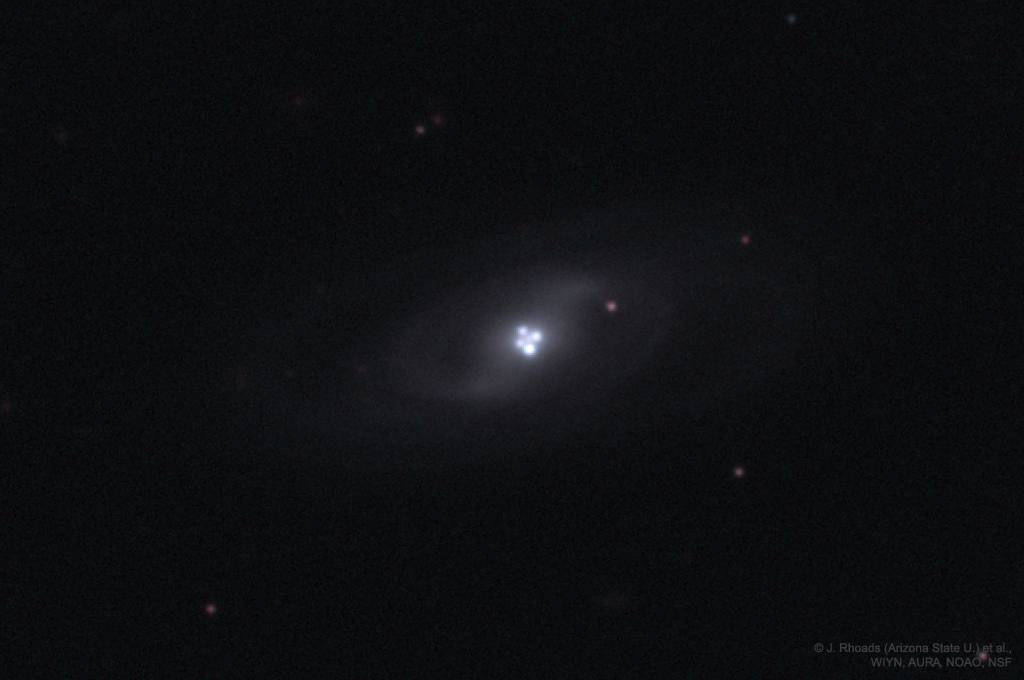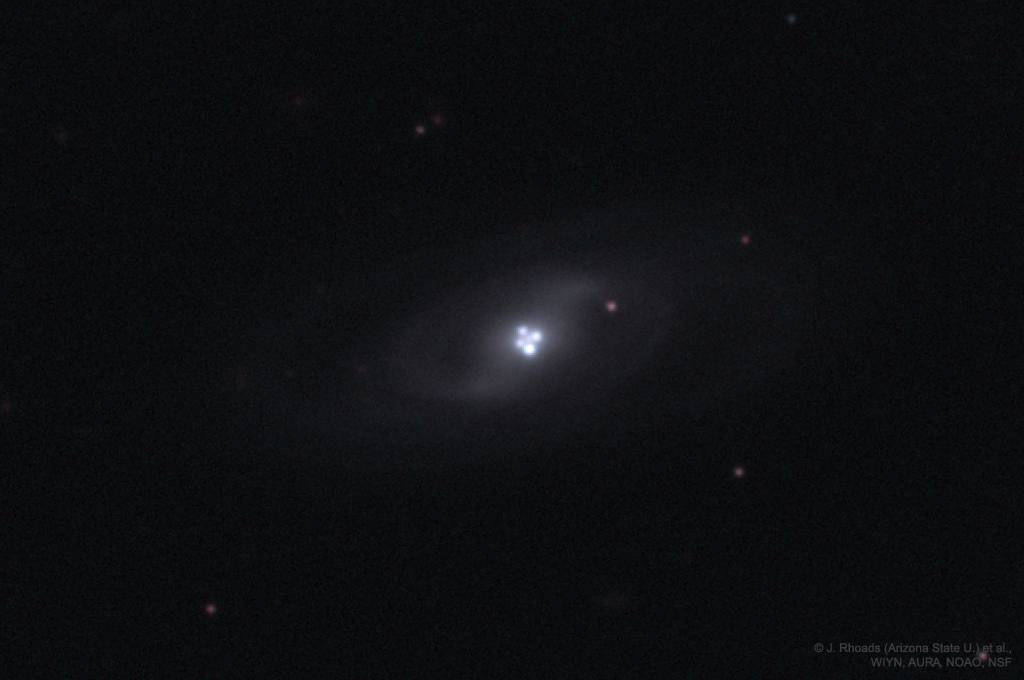
Most galaxies have a single nucleus -- does this galaxy have four? The strange answer leads astronomers to conclude that the nucleus of the surrounding galaxy is not even visible in this image. The central cloverleaf is rather light emitted from a background quasar. The gravitational field of the visible foreground galaxy breaks light from this distant quasar into four distinct images. The quasar must be properly aligned behind the center of a massive galaxy for a mirage like this to be evident. The general effect is known as gravitational lensing, and this specific case is known as the Einstein Cross. Stranger still, the images of the Einstein Cross vary in relative brightness, enhanced occasionally by the additional gravitational microlensing effect of specific stars in the foreground galaxy. Follow APOD on: Facebook (Daily) (Sky) (Spanish) or Google Plus (Daily) (River)
La mayoría de las galaxias tienen un solo núcleo — ¿esta galaxia tiene cuatro? La respuesta extraña lleva a los astrónomos a concluir que el núcleo de la galaxia circundante ni siquiera es visible en esta imagen. El cloverleaf central es en realidad luz emitida por un quásar de fondo. El campo gravitacional de la galaxia visible delante rompe la luz de este quásar distante en cuatro imágenes distintas. El quásar debe estar correctamente alineado detrás del centro de una galaxia masiva para que un espejismo como este sea evidente. El efecto general se conoce como lente gravitacional, y este caso específico se conoce como el Cruce de Einstein. Lo más extraño aún es que las imágenes del Cruce de Einstein varían en su brillo relativo, ocasionalmente intensificadas por el efecto adicional de lente gravitacional microscópico de estrellas específicas en la galaxia delante.