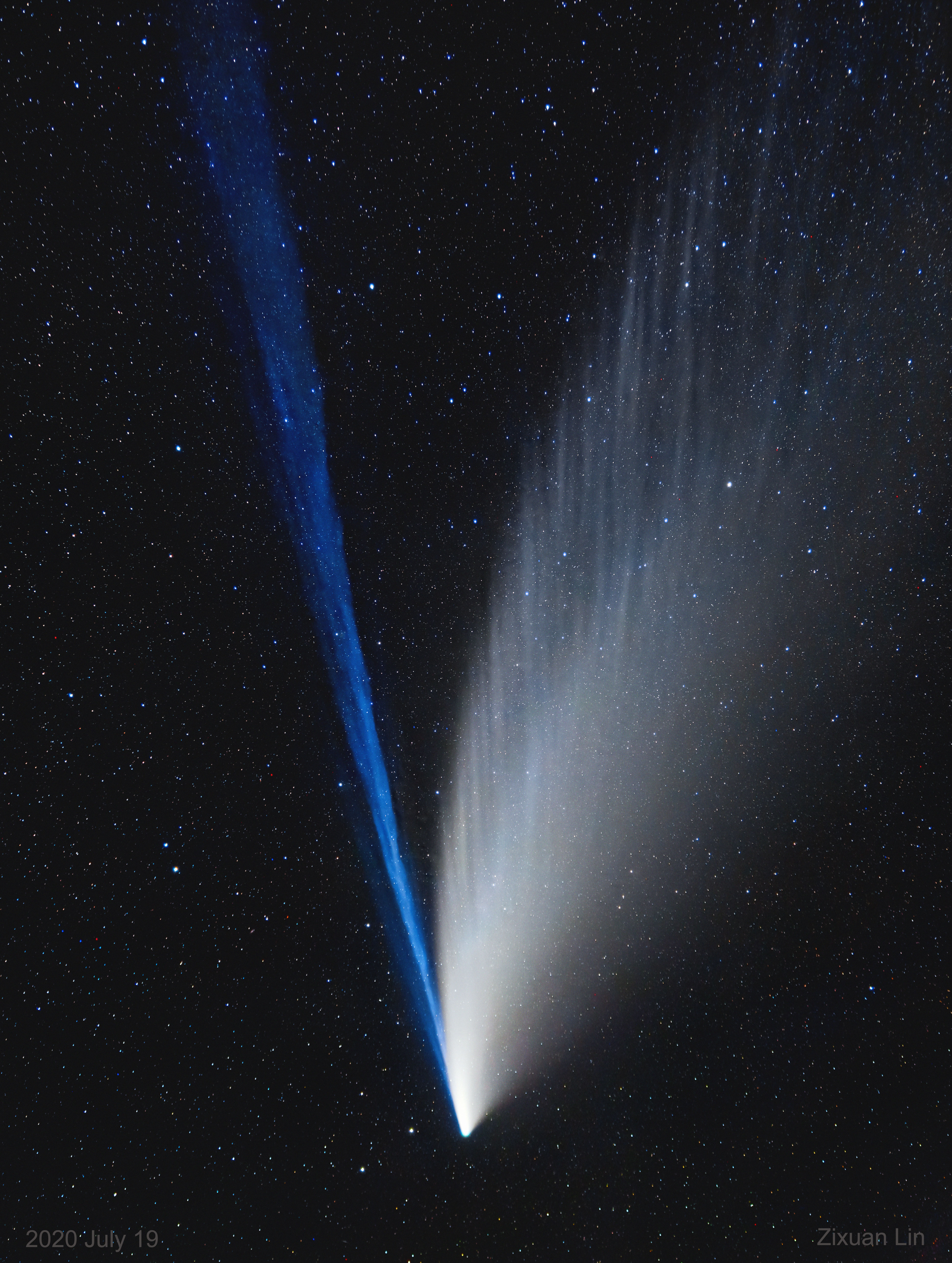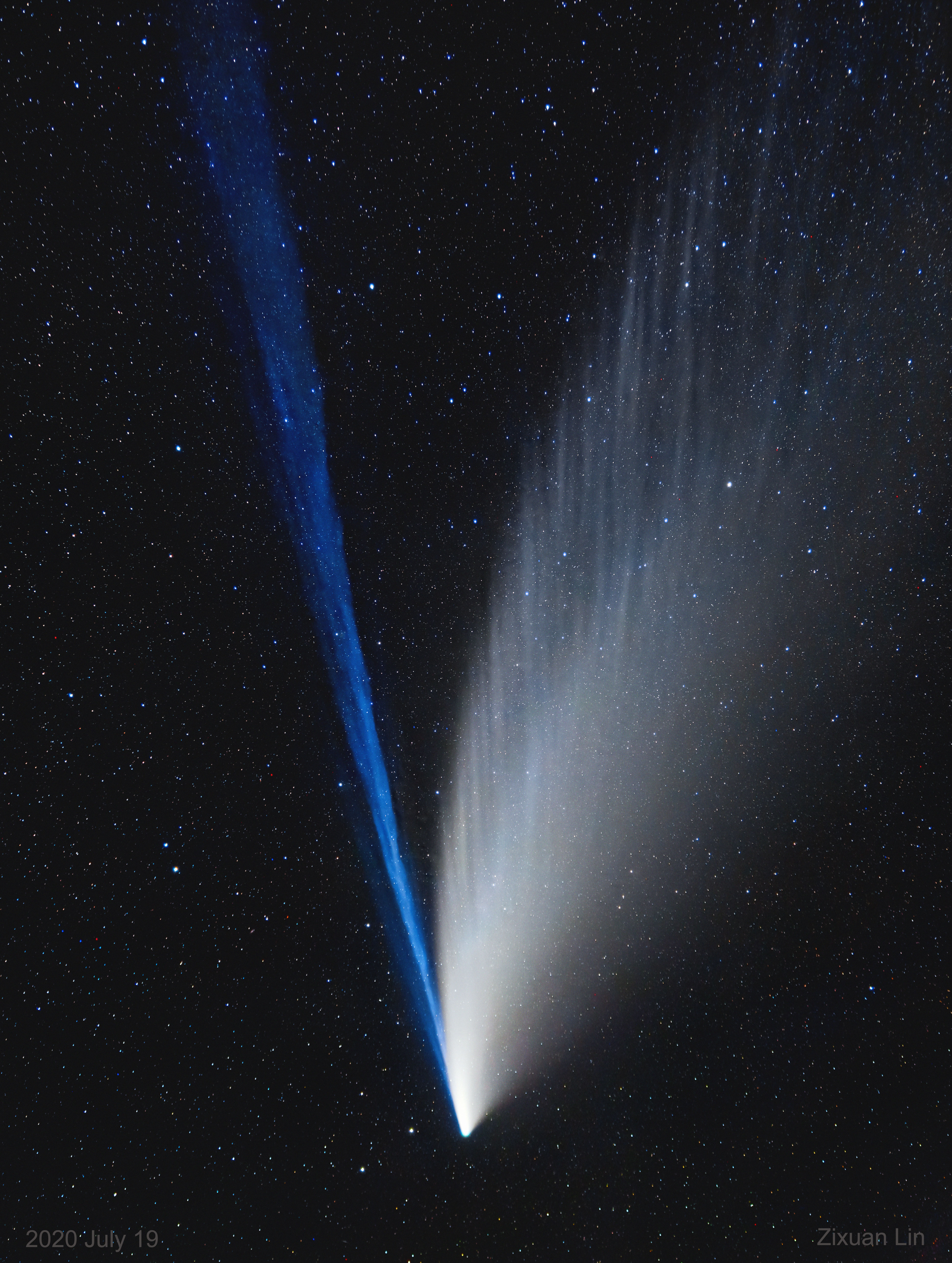
What is creating the structure in Comet NEOWISE's tails? Of the two tails evident, the blue ion tail on the left points directly away from the Sun and is pushed out by the flowing and charged solar wind. Structure in the ion tail comes from different rates of expelled blue-glowing ions from the comet's nucleus, as well as the always complex and continually changing structure of our Sun's wind. Most unusual for Comet C/2020 F3 (NEOWISE), though, is the wavy structure of its dust tail. This dust tail is pushed out by sunlight, but curves as heavier dust particles are better able to resist this light pressure and continue along a solar orbit. Comet NEOWISE's impressive dust-tail striations are not fully understood, as yet, but likely related to rotating streams of sun-reflecting grit liberated by ice melting on its 5-kilometer wide nucleus. The featured 40-image conglomerate, digitally enhanced, was captured three days ago through the dark skies of the Gobi Desert in Inner Mongolia, China. Comet NEOWISE will make it closest pass to the Earth tomorrow as it moves out from the Sun. The comet, already fading but still visible to the unaided eye, should fade more rapidly as it recedes from the Earth. Notable NEOWISE Images Submitted to APOD: July 21 || 20 || 19 || 18 || 17 || 16 || 15 || 14 || 13 || 12 || 11 || 10 & earlier ||
¿Qué está creando la estructura en las colas del cometa NEOWISE? De las dos colas evidentes, la cola iónica azul de la izquierda apunta directamente alejándose del Sol y es empujada hacia afuera por el viento solar en movimiento y cargado. La estructura en la cola iónica proviene de diferentes tasas de emisión de iones azules brillantes desde el núcleo del cometa, así como de la compleja y continuamente cambiante estructura del viento solar. Lo más inusual en el cometa C/2020 F3 (NEOWISE), sin embargo, es la estructura ondulada de su cola de polvo. Esta cola de polvo es empujada hacia afuera por la luz solar, pero se curva ya que partículas de polvo más pesadas son capaces de resistir mejor esta presión luminosa y continuar a lo largo de una órbita alrededor del Sol. Las notables estrías en la cola de polvo del cometa NEOWISE aún no se comprenden completamente, pero probablemente estén relacionadas con corrientes rotativas de partículas reflejantes del sol liberadas por el derretimiento del hielo en su núcleo de 5 kilómetros de ancho. La imagen compuesta de 40 tomas, digitalmente mejorada, fue capturada hace tres días a través del cielo oscuro del desierto de Gobi en Mongolia Interior, China. El cometa NEOWISE hará su paso más cercano a la Tierra mañana mientras se aleja del Sol. El cometa, ya en fase de desvanecimiento pero aún visible a simple vista, debería desvanecerse más rápidamente a medida que se aleje de la Tierra.