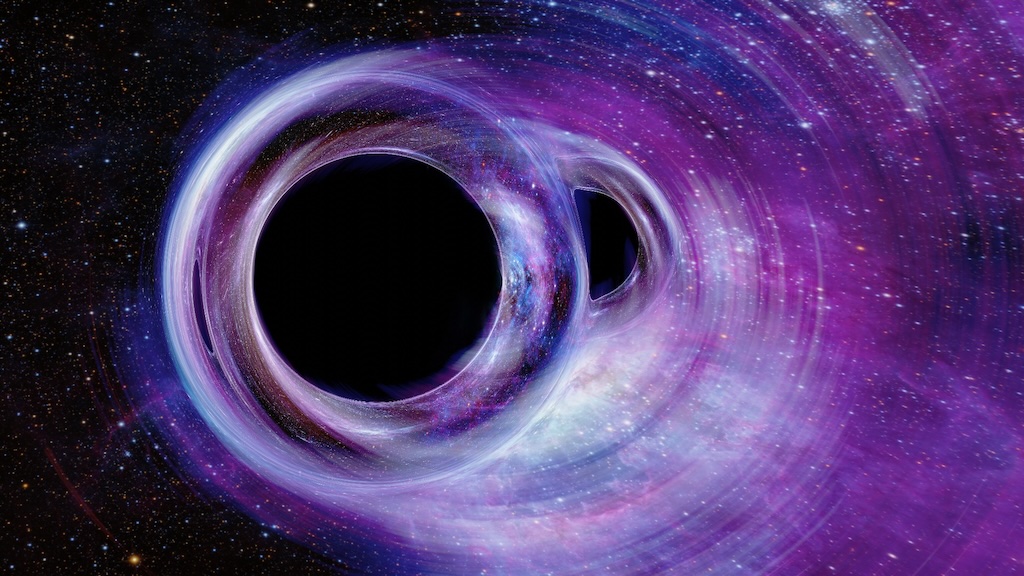
What happens when two black holes collide? This extreme scenario occurs in the centers of many merging galaxies and multiple star systems. The featured video shows a computer animation of the final stages of such a merger, while highlighting the gravitational lensing effects that would appear on a background starfield. The black regions indicate the event horizons of the dynamic duo, while a surrounding ring of shifting background stars indicates the position of their combined Einstein ring. All background stars not only have images visible outside of this Einstein ring, but also have one or more companion images visible on the inside. Eventually the two black holes coalesce. The end stages of such a merger is now known to produce a strong blast of gravitational radiation, providing a new way to see our universe. This Week is: Black Hole Week at NASA
¿Qué ocurre cuando dos agujeros negros colisionan? Esta escena extrema tiene lugar en los centros de muchas galaxias en proceso de fusión y en sistemas estelares múltiples. El video destacado muestra una animación por computadora de las etapas finales de tal fusión, resaltando los efectos de lente gravitacional que aparecerían sobre un campo de estrellas de fondo. Las regiones negras indican los horizontes de sucesos del dúo dinámico, mientras que un anillo circundante de estrellas de fondo en movimiento indica la posición de su anillo de Einstein combinado. Todas las estrellas de fondo no solo tienen imágenes visibles fuera de este anillo de Einstein, sino que también tienen una o más imágenes compañeras visibles en el interior. Finalmente, los dos agujeros negros se fusionan. Las etapas finales de tal fusión se sabe ahora que producen una fuerte explosión de radiación gravitacional, proporcionando una nueva forma de observar nuestro universo.